


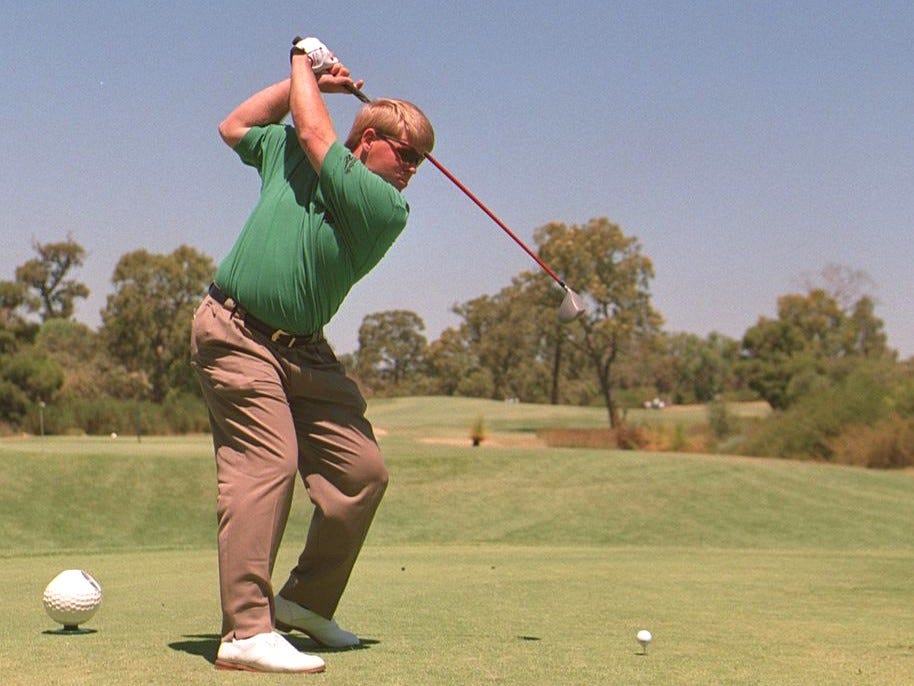
Happy Sunday everyone.
Let’s get into it.
Today’s quote:
“I don’t believe in luck. In golf, you get what you deserve.”
– Annika Sörenstam
Slow-Motion Practice
I shared this video in last week’s premium post, but it’s such an important concept that I wanted everyone to see it here.
Practice in Slow-Motion!
Watch the video below of Tommy Fleetwood practicing:
I think it’s vital that you understand the value of slow-motion movement when trying to change your swing and learn new positions.
Motor-learning research shows that slowing a complex movement improves sensory feedback and error detection, which helps the brain encode new patterns.
I understand the urge to swing at full speed when trying to “feel” new positions. But a full swing is roughly 1.2–1.5 seconds, and at that tempo, the brain cannot consciously monitor sequencing, so your old habits dominate.
If you want to make lasting swing changes, you need to set aside 10-15 balls to dedicate methodical slow-motion movements.
Featured Guides
Free for premium subscribers here
Driver’s Fade Bias
If you read my post from a couple of weeks ago on draws vs fades, you might remember me mentioning how most Tour professionals play a fade with their driver.
There were a few great threads on X last week explaining why modern equipment has a huge role to play in this. I've linked a couple of them below for those interested, but here are the main points:
Toe-Biased Center of Gravity: Equipment manufacturers have shifted the center of gravity closer to the toe. The design caters to the common amateur miss (the toe).
Higher MOI & Face Stability: Newer driver heads feature high resistance to twisting (MOI) around the hosel, making it significantly harder for a player to close the face dynamically through impact.
TL;DR: Modern drivers inherently promote a fade-bias. If a fade is your natural ball flight, forcing a draw is an unnecessary uphill battle.


The Course vs The Range
If I had a dollar for every time I’ve played with someone who said “I don’t understand! I was hitting it so well at the range yesterday. Now I can’t seem to hit anything!”
Oh, you mean you were hitting it well when there was no one watching and you didn’t really care about the result? Of course you were flushing them…

Understand that the range and the course are two entirely different animals.
Your swing WILL be worse on the course. There are nerves, OB, bad lies, expectations, etc… the list goes on. That’s why I recommend you record your swing every now and again when you play just to see how severely you revert back to your bad habits when there’s something on the line.
This is why it’s important you use a mixture of blocked and randomized practice. I wrote about this concept below:

That’s it for today. Hope you all have a great week and get out and play!
If you have any questions, comments, or feedback, please don’t hesitate to email me at tourswingstommy@gmail.com. I read everything.

You can pre-order the digital version of my new book on Amazon HERE.
Social Media: Make sure to follow me on X here.
If you haven’t read them yet, check out some of the most popular Scoring Letter posts below:


