


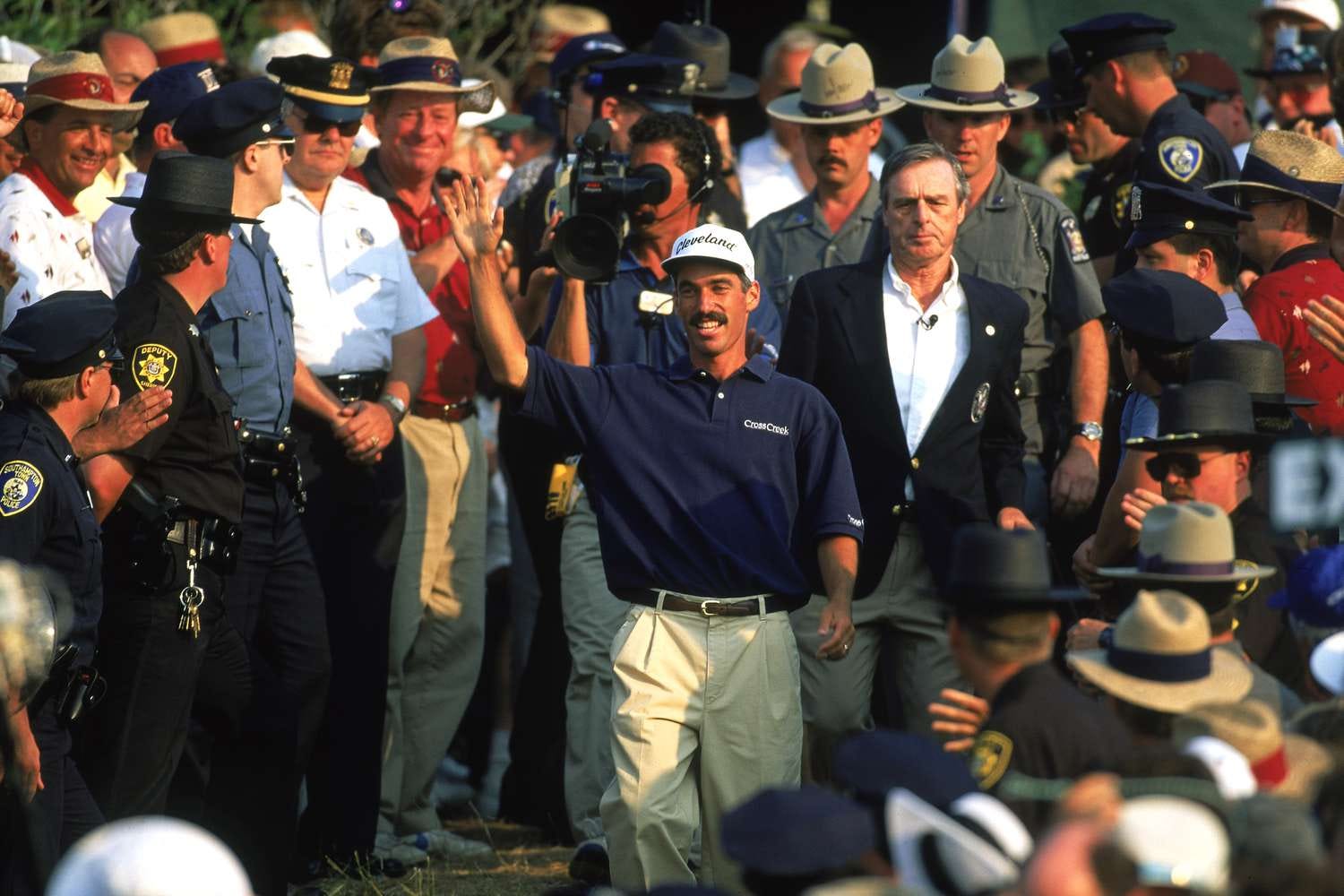
Happy Sunday, everyone, and happy U.S. Open week. We saw some great golf from the women last week (congrats Nelly), and hopefully, we’ll get some more of the same this week at Shinnecock.
Here’s the bag.
“Nobody asked how you looked, just what you shot.”
-Bobby Jones
Alternating Between Putting Grips
I tuned in on Thursday to watch some of the RBC Canadian Open. Something I noticed right away, which I found very interesting, was that Sahith Theegala appeared to be putting with both a left-hand low grip and a conventional grip.


Now, I have seen this before, but the order in which Sahith was doing it seemed backwards to me.
As I mentioned above in my X post, Fred Couples famously has employed this tactic on the Champions Tour. He claims that conventional is better for longer putts because it allows him better distance control and feel. He then switches to left-hand low for shorter, straight putts to lock in his start line.
If you’re curious, or you just enjoy watching Fred Couples highlights for fun like I do, watch the video below.
You’ll see Fred go back and forth between grips: left-hand low for inside 10 feet, and conventional for anything outside of that.
All of this is to say, no one ever said you had to use the same putting grip for the entire round.
Play around with them. You never know — you might find more success using more than one.
Before we continue:
If you want access to the premium posts, snag 20% off your first year’s subscription below. It costs less than a single box of golf balls — and it’s guaranteed to help you lose fewer of them :)
Conflicting Alignment
I posted a video on X last week of a close-up of Aaron Rai attempting a short birdie putt.
You can watch it below:
What immediately stood out to me were the conflicting lines between his putter head and his ball.
For those who read last week’s premium post on lining up your putts, this topic will sound familiar.
Now, no one can say for sure what Aaron Rai’s personal preferences are, or what he’s visualizing here. I can’t even guarantee he lined this up intentionally—after all, the putt was only a few feet. But what I can say for sure is that this exact visual conflict is the reason I personally avoid lining up the ball.
Too often, I stand over a putt and find myself battling competing lines. As soon as I start second-guessing my alignment, I’ve already missed the putt.
This Week’s Premium Post
This week’s premium post will cover how to stop wasting time at the range.
A preview:
When it comes to effective practice, there’s an important distinction you need to understand:
Performance does not always equal learning.
Performance is temporary. It’s how well you hit the ball right now, under your current conditions. Learning is permanent. It’s the actual change in your game. It’s what’s still there next week, on a different course, under pressure, and when it truly counts.
Here’s the uncomfortable truth about practicing in golf: the two are often inversely related.
The exact conditions that make you stripe the ball beautifully on the range are usually the ones that produce the least amount of lasting improvement.
This post will be for premium subs only. If you’d like to upgrade, you can claim your 20% off your first year’s subscription below:
Ball Below Your Feet
During the third round of the U.S. Women’s Open, Gaby Lopez was faced with one of the most subtly challenging shots in golf:
A ball severely below your feet.
Now, if you’ve never attempted this shot before, you may be wondering what the big deal is. On the surface, it looks harmless. But don’t let it fool you… This is the one shot in golf that demands absolutely flawless posture from takeaway to finish.
Watch the clip of Gaby Lopez below and then we’ll discuss it.
Now that you’ve watched, let’s break down exactly what she does so well, and how you can survive unscathed the next time you’re faced with this brutal lie.
The absolute number-one priority on this shot:
Maintaining your posture exactly as it was at address.
On a flat lie, you can sometimes get away with losing your height or lifting out of your swing early. Sure you’ll hit a mishit, but it’s usually manageable. Not with these lies.
With the ball severely below your feet, your margin for error basically evaporates:
If you stand up even a fraction too soon: you’ll top the ball.
If you dip too low: you’ll chunk it.
With these lies, the bottom of your swing arc requires surgical precision. Any vertical movement in your body will immediately throw the club off the strictly required path.
Pro tip:
When you find yourself in this situation, squat a little deeper into your setup and really sit into your stance. Get comfortable, because once you lock that posture in, you aren’t allowed to change it ;)
That’s it for today. Hope you all have a great week and get out and play!
If you have any questions, comments, or feedback, please don’t hesitate to email me at tourswingstommy@gmail.com. I read everything.
Social Media: Make sure to follow me on X here.
If you haven’t read them yet, check out some of the most popular Scoring Letter posts below:


Ball below my feet is a killer for me. There are just two results. An over the top pull hook that winds up well left of the green. Even with pure shots. Or…a weak flare to the right. Well short of the green. I’ve been resorting to simply “bunt” it 50 yards, taking my medicine and having a flat lie. Crazy!