


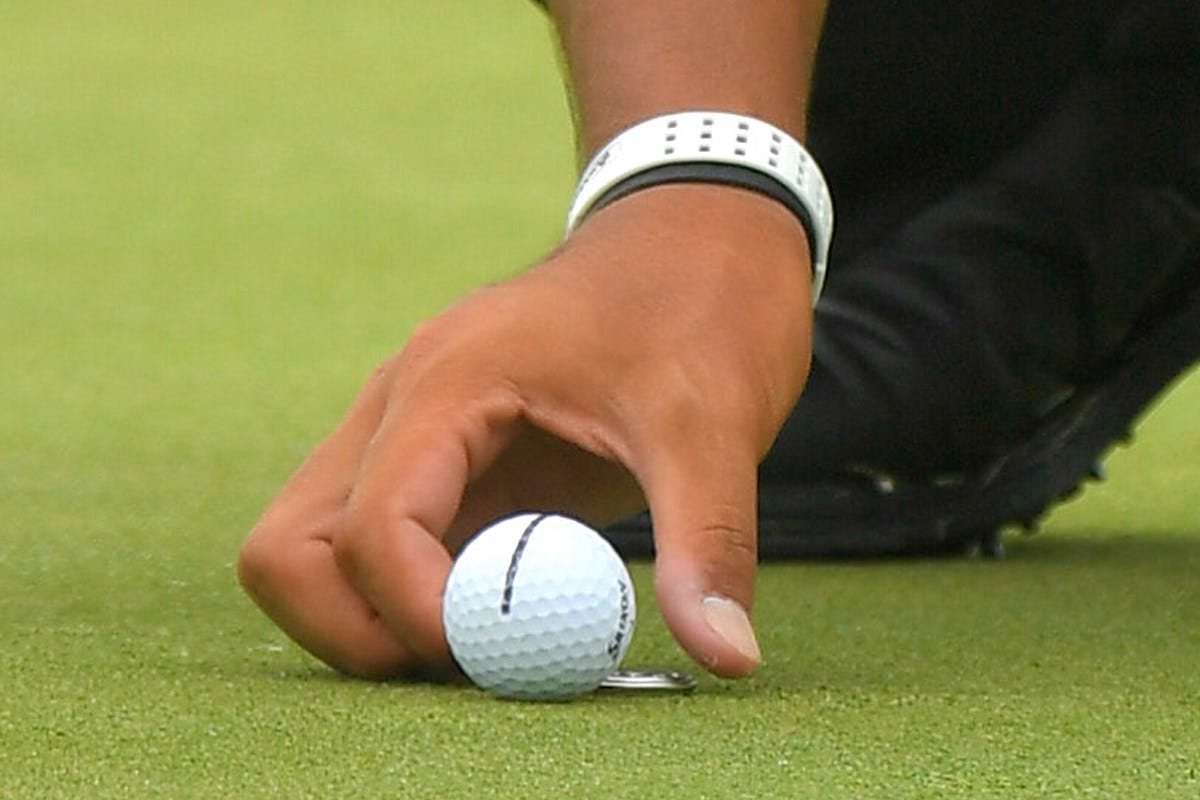
Golf is governed by an endless list of unwritten rules.
Never talk during a backswing. Don’t offer unsolicited swing advice. Keep pace with the group in front of you. And for the most part, we follow these commandments without question, like the good little golfers we are.
But of all the unspoken rules I see amateurs strictly adhering to, one reigns supreme:
Always line up your putt using the line on the ball.
Let me be clear. Using the line isn’t wrong. It can be very beneficial if done correctly. Also, it looks pretty damn cool right? Squatting down behind your ball, adjusting its alignment, then gently lifting your marker. It’s one of the few ways you can pretend to be a tour pro.

The case for doing it practically writes itself: most golfers have terrible aim, the physical line removes the guesswork, and eliminating guesswork is how you lower your handicap.
Makes perfect sense.
But what does the data say? And maybe more importantly, does the data even matter?
Because at the end of the day, the only thing that matters is what produces results for you. And the truth is for most golfers, lining up the ball might just be a ritual masquerading as a solution.
The Case For Using The Line
The case for using a line starts with a simple, unfortunate fact:
Most amateur golfers have almost no idea where they are actually aiming.
Dave Pelz spent decades running tests at his golf schools. One of his experiments was attaching lasers to putters to see exactly where players aimed at address. His findings were brutal: from just ten feet away, the vast majority of amateurs were convinced they were aimed dead center, when in reality, their putters were pointed well outside the hole.
The gap between perceived aim and actual aim is surprisingly large, and it’s the dominant variable in why short putts are missed so often.

Against this backdrop, the line is an entirely logical response. If you can’t trust your eyes to aim the putter, then give yourself something external to look at. Translate your read into a physical direction, set the ball down with that instruction literally encoded on it, then simply execute.
The decision is made. The doubt is resolved. All that remains is the stroke.
“I use the line on the ball to make sure my eyes are seeing it right. If I line it up from behind and get over it, and it looks a little off, I trust the line. Your eyes can play tricks on you depending on the slope, but the line doesn't lie.”
-Tiger Woods
Before we continue:
If you want access to the premium posts, snag 20% off your first year’s subscription below. It costs less than a single box of golf balls — and it’s guaranteed to help you lose fewer of them :)
What Does The Data Say?
So far there really have only been a handful of controlled studies to test whether a line improves putting performance.
All of the studies disagree.
The first one, conducted at Baylor University in 2012, tested forty-eight golfers. Of those golfers, half were experts (D1 golfers) and half were novice (college students who never really play).
They had them hit putts from three feet and thirteen feet, with and without an alignment line. They used a SAM PuttLab, which is a device that measures putter aim to a tenth of a degree, precise enough to detect differences the human eye cannot see.
The results:
