


Happy Sunday, golfers. It’s a special Sunday for golf fans with two great events wrapping up today: the final round of the St. Jude Championship and the U.S. Amateur final.
If you’d rather skip today’s Sunday Bag and tune into the U.S. Am instead, I won’t blame you.
Anyway, let’s get into it.
Today’s quote:
“A good player who is a great putter is a match for any golfer. A great hitter who cannot putt is a match for no one.”
- Ben Sayers
PGA Range Sessions
Starting this year, the PGA Tour began tracking every single shot hit on the driving range. Luke Kerr-Dineen at Golf Digest recently analyzed the data from a massive 250,000-shot session and shared 10 key takeaways (you can read his full article here).

A couple of those insights stood out to me as particularly useful, and possibly worth applying to your own practice sessions:
Irons and Wedges
On average, the players' two biggest chunks of practice shots came from their short-and-mid irons (shots from 130-190), and with their wedges (shots inside 130 yards). Those two categories account for more than 55 percent of players' range sessions.
I’ve written in the past about how approach play is the highest ROI for your practice time. It accounts for the largest share of your strokes gained data. You have to be able to get on the green from 170 yards and in consistently. Putting practice might make you feel good, but iron practice will drop your index.
Switching Clubs Constantly
The data shows that players average only two or three shots with the same club before moving on to a new one. I’ve written about this concept of randomized practice here.
There is a time and place to focus on hitting one club for an extended period of time, but in general, randomizing your practice and forcing your mind and body to adapt to new targets and distances is more effective training.
Anyone can find a groove hitting the same club over and over. The real test is how well you can jump straight from a full 5-iron to a partial 56° wedge.
Featured Guides
Free for premium subscribers here

Jason Day Wedge Tips
This is something I’ve written about in previous Sunday Bag posts, but I think three-quarter wedge shots is a massively underutilized shot in the amateur arsenal.
Below is a clip from Jason Day’s YouTube channel where he explains why Tour Pros rarely take full swings with their wedges.
(You can watch the full video on his channel here)
He later goes on to explain why higher-spin clubs like wedges are more susceptible to wind, which is another reason why it’s so important to keep their trajectory lower.
I can’t tell you how many times I’ve taken a full swing with a 60° wedge, only to watch it balloon into the air and land 20 yards short. Learning to control the trajectory and hit these “flighted” wedge shots was a massive turning point in continuing to drop my index once I hit around a 5.
Getting from mid single digit down to scratch requires consistency from 100 yards and in, and I think flighted wedge shots are essential to making that leap.
This Week’s Premium Post
This week’s premium post will be
A preview:
The golf swing is a constant balancing act of correcting, overcorrecting, and backtracking—a tug-of-war of opposing forces that somehow keep things in order.
Eventually, however, you have to pick a ball flight and commit to it.
Being able to consistently eliminate one side of the course is a confidence boost most golfers only dream of. Despite what your coworker or brother-in-law claims, he cannot reliably work the ball both ways.
In fact, a lot of the guys on Tour don't like to either. Most of the best players in the world prefer to own one stock shot shape, keeping the other in reserve only when absolute necessity demands it.
This post will be for premium subs only. If you’d like to upgrade, I offer a special discount for The Sunday Bag readers HERE.
Playing More and Regressing
How many of you have experienced playing more golf, only to feel like your swing is somehow getting worse? I’ve felt this dozens of times, and it’s maddening.
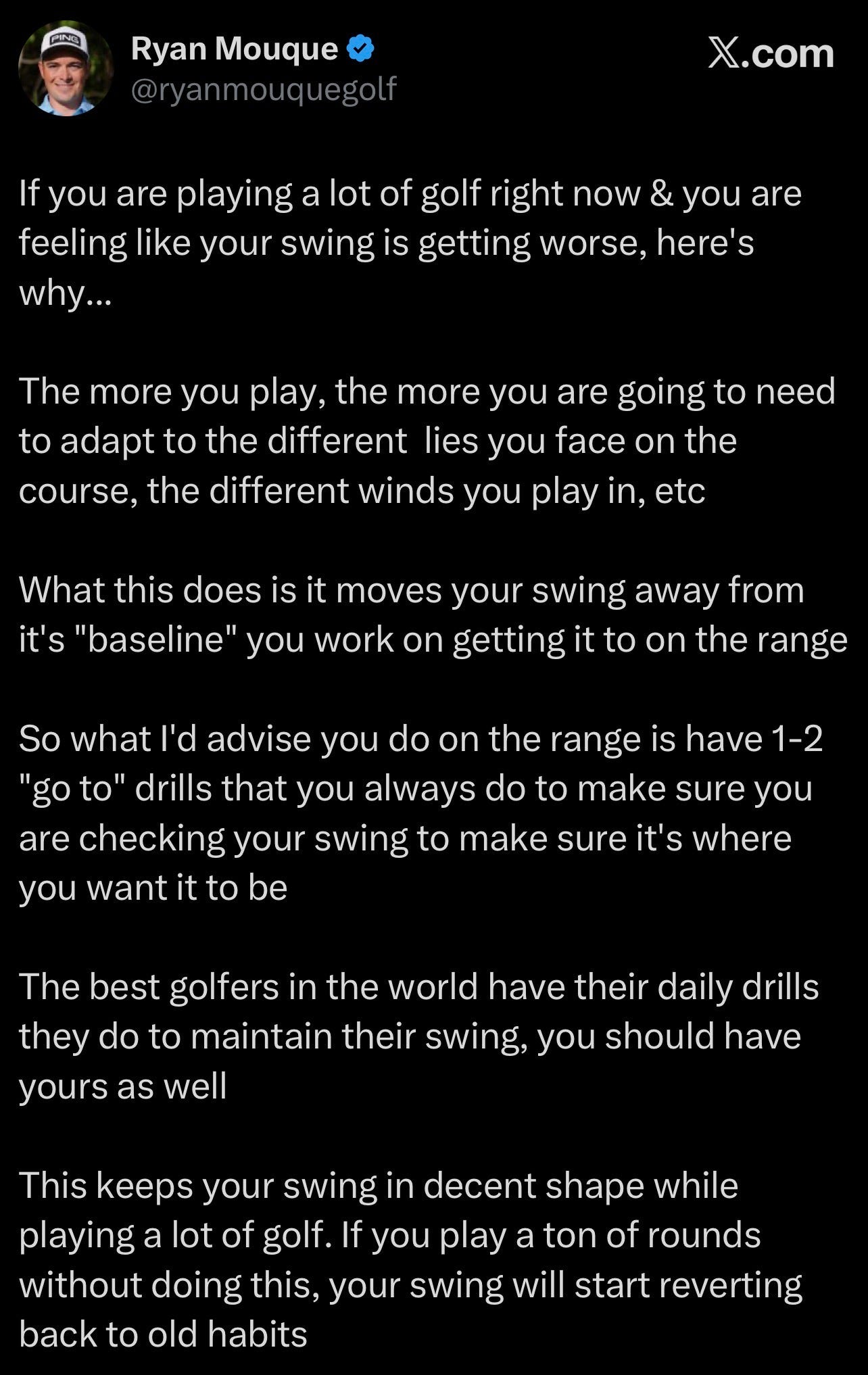
Ryan Mouque shared a great post last week on this exact topic of “regression,” and it’s really helpful for understanding why this happens.
A lot of what I write about in this newsletter focuses on improving through smarter decision-making. I try to stay away from swing advice because the online instruction pool is already so saturated. However, completely ignoring your mechanics and only playing rounds of golf will ultimately limit your progress.
It’s important to understand that ingraining new motor skills requires repetition — something a round of golf doesn't provide the way a range session does.
I’m not saying the range is better than the course. But if you only play and never practice, you’ll slowly find yourself reverting to old habits, just like Ryan points out.
That’s it for today. Hope you all have a great week and get out and play!
If you have any questions, comments, or feedback, please don’t hesitate to email me at tourswingstommy@gmail.com. I read everything.

You can pre-order the digital version of my new book on Amazon HERE.
Social Media: Make sure to follow me on X here.
If you haven’t read them yet, check out some of the most popular Scoring Letter posts below:


