


Happy Sunday, golfers.
In last week’s premium post, I wrote about the 5 statistics that I believe will change the way you play golf. To my surprise, it ended up being my most successful post. So if you haven’t had a chance to read it yet, go check it out! I made it free for everyone.

Let’s get into it.
Today’s quote:
“Golf… is the infallible test. The man who can go into a patch of rough alone, with the knowledge that only God is watching him, and play his ball where it lies, is the man who will serve you faithfully and well.”
— P.G. Wodehouse
Ditch the Three-Foot Circle
I subscribe to the Golf Digest newsletter, and in it, they sometimes have a segment called the "2-Minute Clinic". In their latest edition, PGA Tour pro Ben Griffin shared a putting tip that really resonated with me, and I think you’ll find it just as valuable.

I’m sure at some point you’ve been told to try to finish your lag putts inside of a three-foot circle. Griffin challenges that advice. He says:
If you're thinking about getting the ball into a three-foot circle but then miss by two feet, now you've got to contend with a testy five-footer. But when you try to make it, you sharpen your focus, and the miss usually ends up in that three-foot circle for an easier second putt.
You’ve all heard the classic adage "aim small, miss small," and lag putting is no exception. A three-foot circle is a great zone to finish in, but it shouldn't be your target. Aiming at a precise point narrows your margin for error.
Brad Faxon preaches a similar mindset, emphasizing that he approaches every putt with the intention to make it:
Every putt, if you can match the speed and the line, has a chance to go in. The more you can downplay the importance of the putt, the better chance you'll have to make it.
But remember: trying to make long putts isn't a license to ram the ball five feet past the hole. You still need proper speed control and lag fundamentals. So stop with the vague three-foot circle target, and treat your lag putts with the same precise, deliberate aim that you treat your shorter putts with.
First Hole Struggles
Nothing beats the anticipation of a round of golf. If you’re a psychopath like me, you might even find yourself visualizing the first tee as you’re lying in bed the night before. It’s a clean slate, a fresh start, and a chance to finally play the kind of golf you know you're capable of.
And then you get to the course and double the first hole…
Do you feel like this happens to you often? Well it probably does, but go easy on yourself. It happens to good players too. According to data from Lou Stagner at Arccos Golf, even college golfers consistently score worse on their opening hole. In fact, it typically takes them a few holes just to settle in and catch up to the field average.


There could be a number of different explanations — first-tee jitters, shotgun starts, cold morning air, just to name a few. But the fact remains: even D1 college golfers struggle right out of the gate. So if you’re a 15-handicap rolling up to the course five minutes before your tee time with zero warmup, cut yourself some slack and don’t panic when the first hole doesn’t go well.
Waste Area or Bunker?
Have you ever found your ball 200 yards from the green sitting in sand, only to be told you can’t ground your club because it’s still a "bunker"?
Well, hold on a second. Depending on the course you’re playing, you might be hitting from a waste area, which means the standard bunker rules don’t apply!
The USGA recently released a video on waste areas and why you’re allowed to play them just like regular fairway shots. Check it out below:
The USGA didn't actually explain how to spot the difference between a bunker and a waste area. But don’t worry, that’s what I’m here for.
Here’s a quick cheat sheet to help you figure out whether traditional bunker rules apply or not.
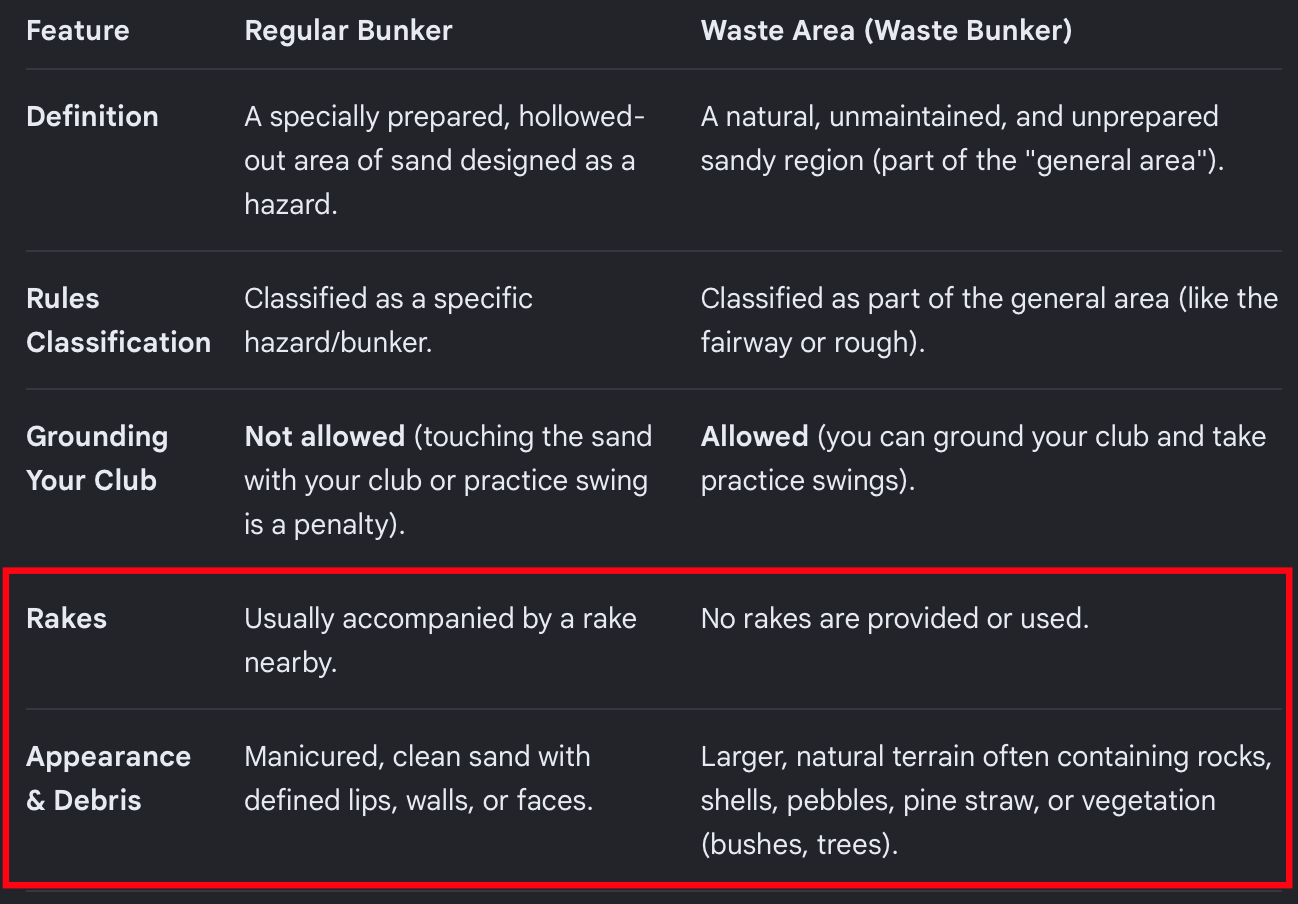
TL;DR: Just look for a rake.
That’s it for today. Thanks for reading.
Hope you all have a great week and get out and play!
-Tommy
Tommy’s Recommendations
Leverage the power of AI track to your shots and analyze your tendencies. Start your Arccos membership today.
A quality rangefinder is worth paying for. Bushnell is the most used rangefinder on Tour for good reason.
You know how valuable distance is. If you want to add clubhead speed with a structured, proven program, check out The Stack. Use code TOMMY for 10% off.
Resources
Grab a copy of my ebook The Game Within the Game (free for paying subscribers here).
Follow me on X here.
Email me at tourswingstommy@gmail.com
Claim 25% off your first year’s subscription here.

Most Popular Posts
Highest ROI for Your Practice Time
The Only 3 Golf Training Aids You Need
You’re Chipping with the Wrong Club