



Welcome, golfers.
As we approach the one-year anniversary of The Scoring Letter, I’ve been reflecting on all the content I’ve put out and all the lessons I’ve learned along the way. I started this newsletter with a simple goal: to help amateur golfers shoot lower scores through smarter play.
Each week, I dive into topics that spark my curiosity and share those findings with you. Unsurprisingly, researching golf every week has provided me with a steady stream of insights — some of which have proven far more impactful than others.
So, for this week’s post, I wanted to share the 5 statistics that I believe are most impactful to your game.
I’ve decided to make this post free for everyone as a thank you for all of the support and positive feedback I’ve received since starting this little project.
If you’d like to support my work — and unlock the 40+ premium strategy breakdowns in the archive — you can upgrade your subscription HERE. You’ll also get a free digital copy of my book The Game Within the Game.
Okay, let's get into it.
#1: You Don’t Need to Hit Fairways
There are a few key statistics that signal you’re scoring well. Hitting fairways is not one of them. Let me explain.

Generally speaking, if you’re hitting a ton of fairways, that means you’re prioritizing accuracy off the tee, which means you’re not prioritizing distance off the tee — and that’s a huge mistake.
Distance off the tee is one of the most important skills in golf for a pretty simple reason: it makes your next shot a whole lot shorter.
Now obviously a 280-yard drive in the fairway beats a 280-yard drive in the rough. But that’s rarely the trade-off we're making on the course when we talk about trying to hit fairways.
Strokes Gained data has revealed that proximity to the hole is the single most important factor in approach performance. A 130-yard shot from the rough yields a better scoring average than a 160-yard shot from the center of the fairway. Why? Because as you move farther back, your dispersion pattern expands exponentially.
As long as you stay in play and leave yourself a clear line to the green, distance consistently trumps accuracy off the tee. When it comes to statistics that actually predict low scores, Greens in Regulation carries far more weight than fairways hit.
Take a look at this chart below:
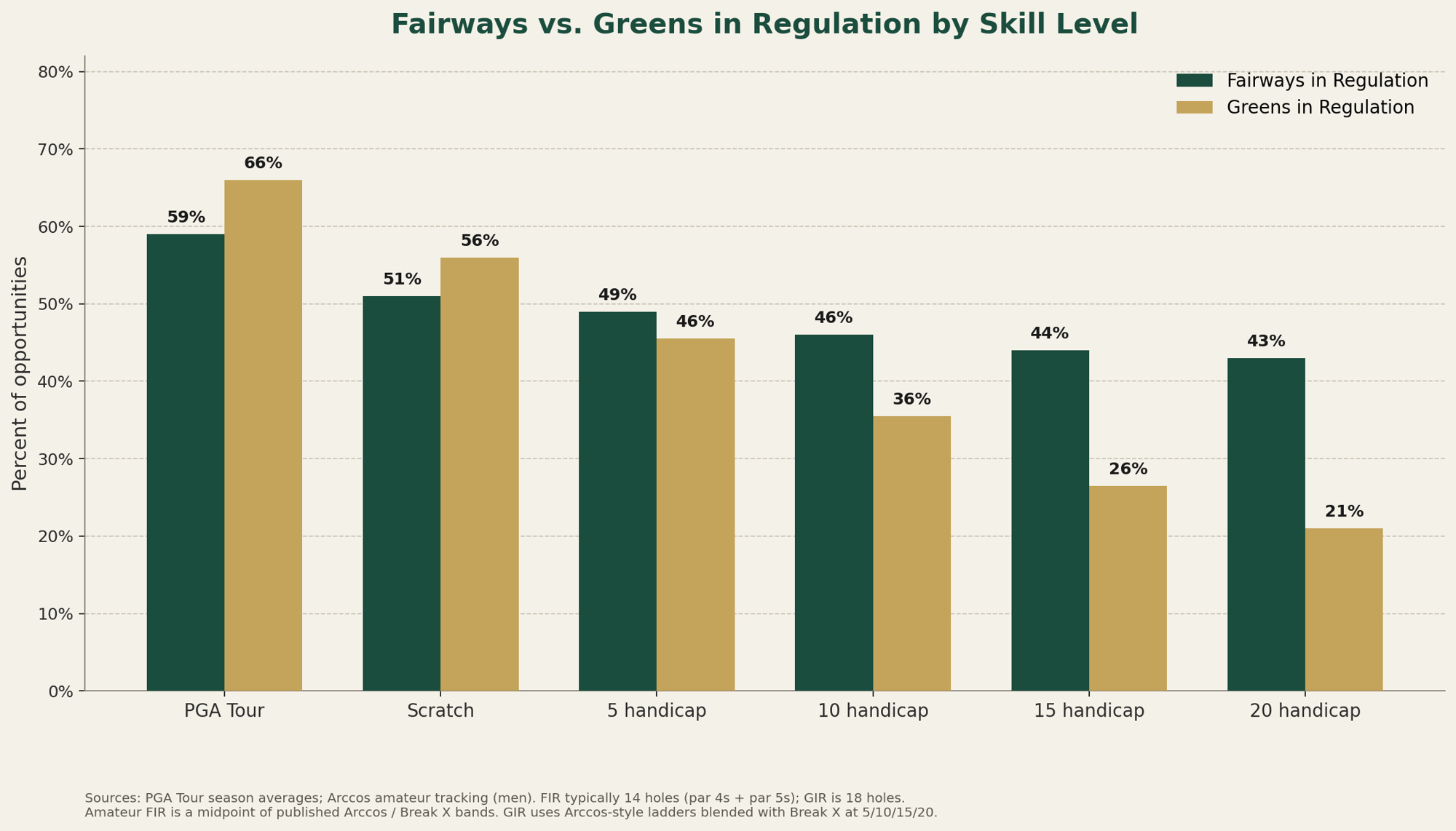
A PGA Tour pro hits around 59% of fairways. A 20 handicap hits around 43%. Yes you read that correctly.
Now take a look at their respective greens in regulation. 66% to 21%.
There are a number of different reasons for this, but the point remains: hitting fairways is not strongly linked to scoring well or playing high-level golf.
A quick word before we continue:
If you subscribe to this newsletter, then you already know how critical it is to track your shots and analyze your tendencies. For anyone unfamiliar, Arccos makes smart sensors and AI-powered trackers that automatically record every shot you hit on the course so you can see exactly where to improve. They have a big fall sale going on right now. So go check them out here before it’s over.

#2: Approach Play is the Most Important Part of the Game
If you ask most amateur golfers where they are losing strokes, most of them will tell you it’s the short game. “I just can’t get up and down,” they say.
But have they stopped to wonder why they are always needing to get up and down in the first place?

Mark Broadie (the Columbia professor who created strokes-gained) analyzed thousands of amateur rounds and concluded:
“About two-thirds of a 10-stroke difference comes from shots outside of 100 yards.”
AKA: Driving and approach play accounts for 67% of the scoring gap between players.
Here is his full breakdown:
Driving ≈ 28%
Approach shots ≈ 39%
Short game ≈ 19%
Putting ≈ 14%
The biggest separator between average players and good players is in ball-striking quality — which shows up the most in approach shots (and driving).
Better approach shots lead to more greens in regulation, which leads to fewer scrambling situations, shorter first putts, fewer three-putts, and lower scores.
I’ll refer you to the same chart from earlier but with a different context:
Look at the drop-off in Greens in Regulation. While distance off the tee plays a role, the big issue is simply how much amateur golfers struggle with a mid-iron in hand.
So next time you’re at the range, skip the putting practice. Learn to hit your 6-iron…
#3: You Don’t Need More Birdies. You Need Less Double Bogeys.
Millions of golfers remain stuck in mid-handicap purgatory. Desperate to break through, they press — chasing distance off the tee, firing at tucked pins, going for every par 5 in two — all hoping that a few more birdie chances might finally break them through to the next level.
But who ever said making more birdies was your path to the next level?
Take a look at the chart below and tell me what you see.
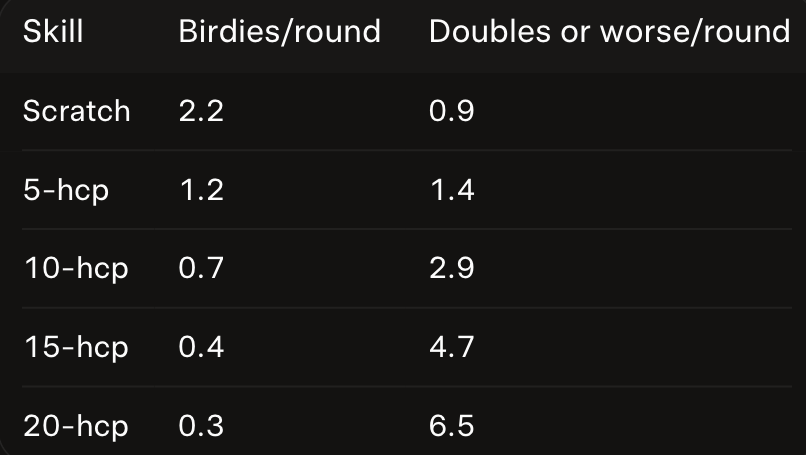
The gap in handicap is not from the birdie gap. It’s from the double bogey gap. By a factor of three.
Another way to view this: A 20-handicap who magically gained scratch-level birdie-making would save roughly two strokes a round. A 20-handicap who magically gained scratch-level bogey-avoidance would save six.
Aside from approach play, understanding this concept may be the single most transformative thing for your game.
Lower scores do not come from dropping strokes. They come from not adding them.
If you want to read my full piece on this topic, you can do so below:

#4: Effective Hole Size
This is less of a statistic and more of a concept, but I still think it will change the way you golf forever.
There are two forces at play when you hit a putt into the hole:
Once the ball rolls past the front edge of the hole, gravity begins pulling it downward into the cup.
As the putt approaches the front edge, there is forward momentum carrying it toward the back of the cup.
For the putt to fall in, gravity has to drop the ball before its forward momentum carries it past the back lip.
The faster the ball is moving, the less time the hole’s gravity has to work.

At a high enough velocity, the ball simply skips across the hole rather than falling into it. This is how most lip outs happen. You may have had a great line, but your speed made the effective hole size too small.
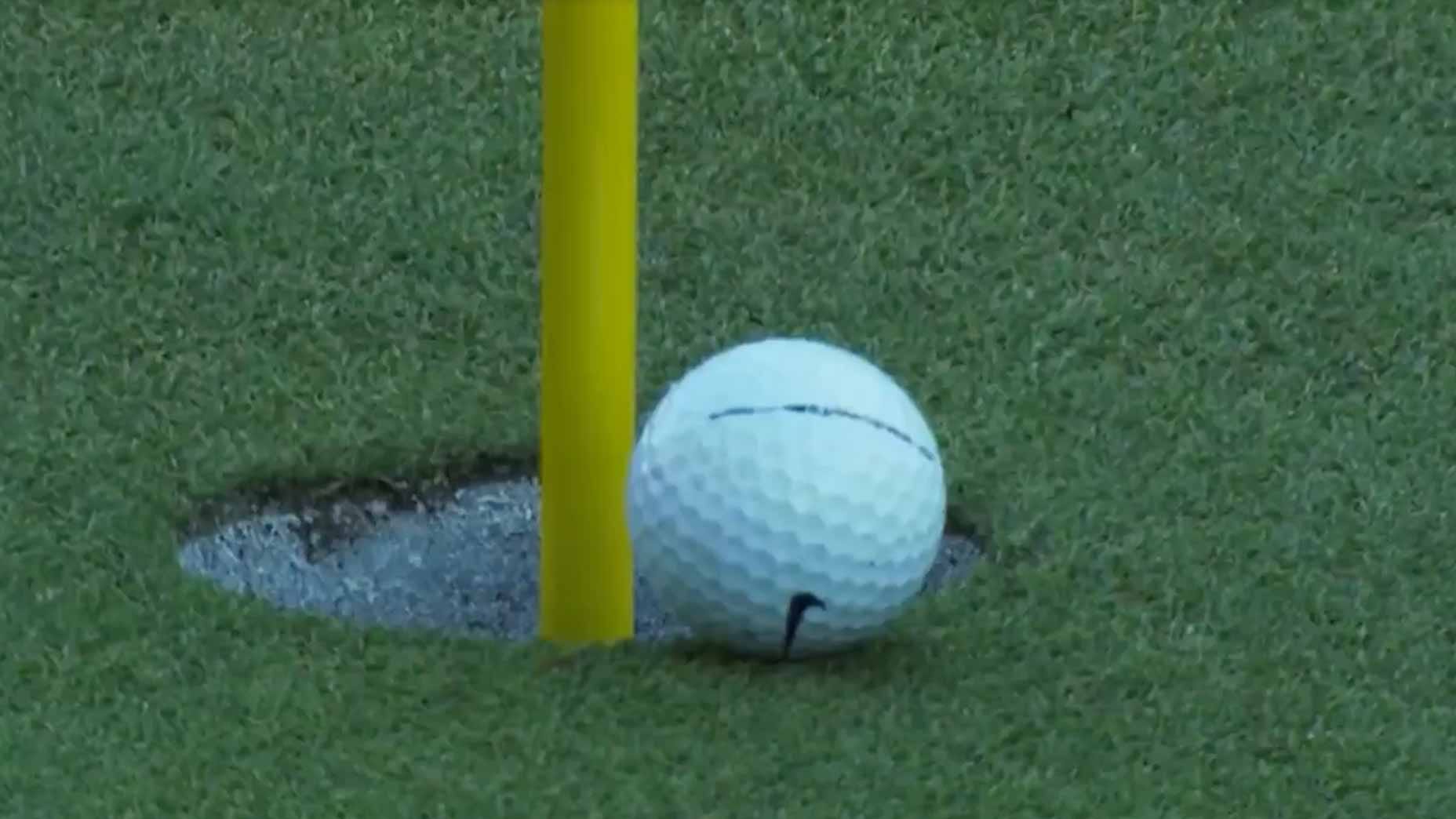
There’s a concept called capture width, and it ties all of this together perfectly. It puts a precise numerical value on how much of the hole is actually available to you depending on the speed of your putt.
AimPoint golf produced the data, but I tried to transform it into a cleaner visual for you all.
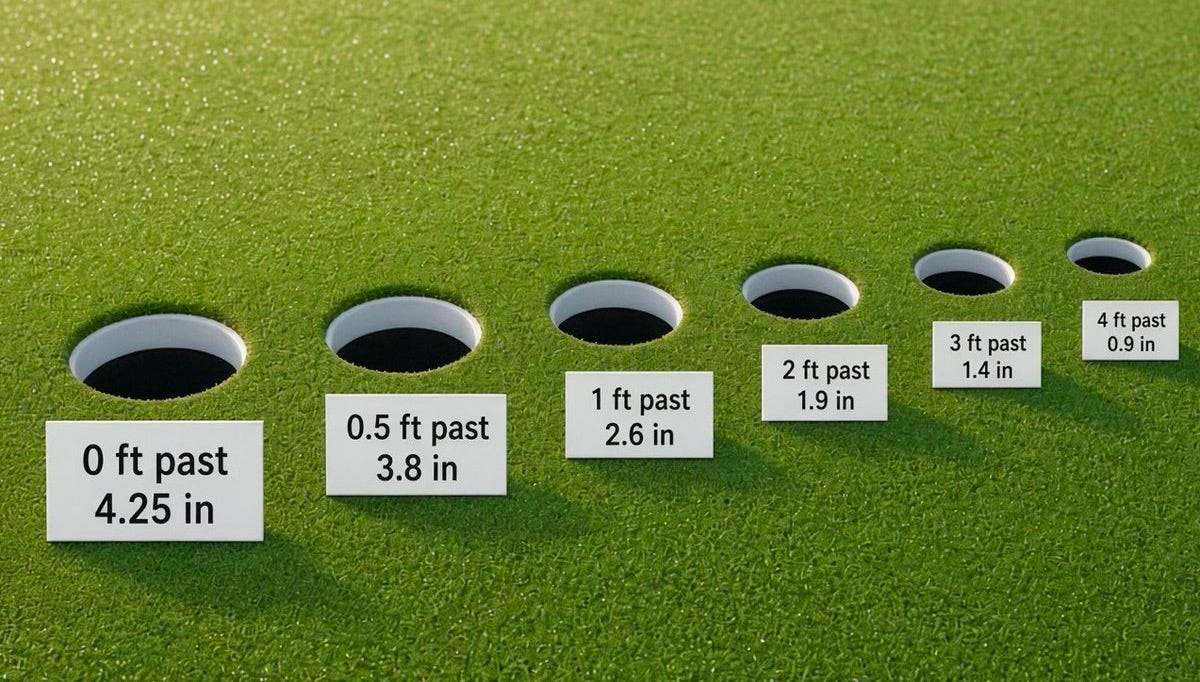
It basically just helps you conceptualize the tradeoff you face when you putt a ball with more speed. Sure it takes the break out, but the effective hole size and capture width get smaller.
#5: Stop Chipping with Your 60°
If you’re like most amateurs, you probably reach for the 58 or 60 degree automatically, because that’s what “good chipping” looks like in your head. High, soft, and spiny. That’s how the pros do it. Why shouldn’t you?
Well unfortunately, the data is pretty clear on which clubs are most effective around the greens for amateur golfers, and your 60° is not one of them. I mean sure, there are situations where a high lofted wedge is required to carry a bunker and get the ball to stop quickly. But those situations are rarer than you think.

The reality is, if you’re between a 10-15 handicap, more loft is your enemy around greens.
Have a look at these two tables:


For a straight forward chip shot with plenty of green to work with, using a pitching wedge over a 60° just makes more sense for mid-handicappers.
A lower-lofted club requires a shorter swing arc to produce the same carry distance. Shorter arc means less timing variance, fewer moving parts, and a genuinely larger window for imperfect contact.
Once again, I’m not saying more loft is never the answer. I’m just saying it’s not the answer in far more situations than most of us realize.
The Final Takeaway
Golf is endlessly complicated yet hilariously simple: get the ball in the hole in as few strokes as possible.
Despite that simplicity, leveraging modern stats and analytics is one of the most effective ways to seriously lower your scores.
I hope you guys enjoyed this post. Please comment down below if there’s another stat that changed the way you play the game. I’d love to hear it.
See you next time,
Tommy

For all of my books and guides click here.
Social Media: Make sure to follow me on X here.
If you have any questions, comments, or feedback, please don’t hesitate to email me at tourswingstommy@gmail.com. I read everything.
Great piece. Simple and to the point. Thanks.