

Happy Sunday, everyone.
Here’s what’s in today’s bag:
Should you be utilizing AI to improve your golf swing?
How much does a lightly-scuffed golf ball affect performance?
Mark Broadie answers the age-old question of lay up or go for it.
AI Golf Coach
If you haven’t heard, AI is coming for your job. But it doesn’t want any old job. It wants to be a golf coach…
Rick Golfs posted an interesting photo showcasing a swing breakdown created for him by Claude. And according to him, the breakdown aligns with the swing advice he’s been given by pros in real life.


I think if you’re a beginner golfer, and you’re unfamiliar with "simpler" swing concepts such as face angle, posture, swing plane, etc, then I think you’d be foolish not to take advantage of this.
As you improve, utilizing AI as a swing coach will have diminishing returns, but it’s still worth toying around with. You never know what you might find. Bryson DeChambeau has notoriously talked about using it in his own game.
It’s also worth noting: while AI can diagnose a symptom, it might not be great at identifying the root cause.
That being said, I do think there are a ton of other ways to use AI to improve at golf.
I wrote a piece a while back on Using AI To Improve at Golf. You can also check out my AI Golf Prompt List if you’re a premium subscriber.
The Pro Shop
I put together a list of items that I think are essential to improving your game and playing high-level golf. You can check it out here.
Ball Scuffs
How many times have you reached deep into your golf bag and pulled out a golf ball that looks like this:
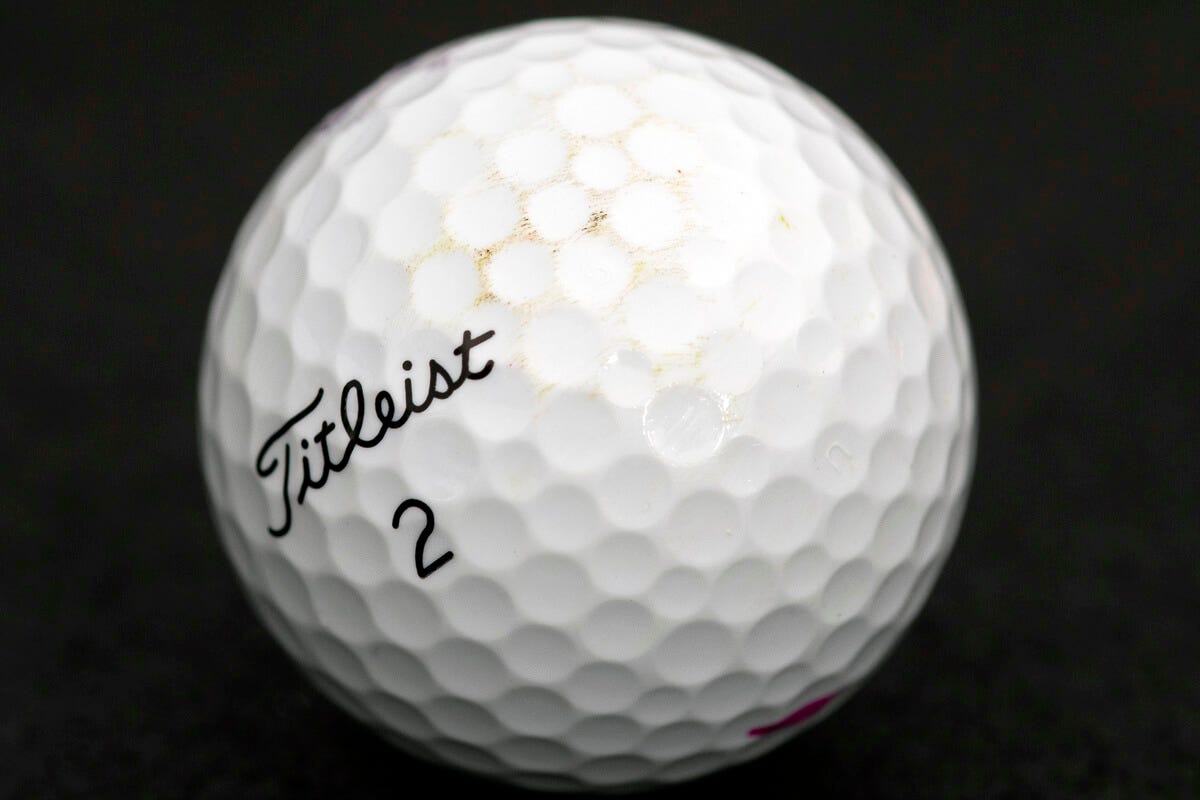
If you’re having a bad round, you may be seeking these balls out. But if you care about your performance, it might be smart to save these for the practice green.
MyGolfSpy recently released an interesting study comparing mud balls vs scuffed balls vs new balls.
I’m assuming if you subscribe to this newsletter then you’re not the type of golfer to use a severely damaged golf ball. So I’m going to ignore those and only share what they discovered for the “lightly scuffed” balls.
This is taken directly from MyGolfSpy:
Even with what amounts to a small but noticeable scrape—the kind of thing you often find after bouncing one off the cart path—there was a noticeable impact on ball flight.
Our lightly scuffed ball had a pronounced, though not massive, shift in the spin axis, resulting in a shot that flew more than eight yards off line.
Peak height was well below the average for an unscuffed ball, though a significantly flatter descent angle contributed to a massive amount of roll.
Now I’ll be honest, I have used “lightly scuffed” golf balls many times throughout a round, but I always assumed the impact on performance was negligible.
So for those (like me) who have always wondered, it seems it’s safer just to not use them at all.
