



You stand over your ball on the tee box, staring down the ever-elusive fairway.
“Just hit the fairway,” you say to yourself. “Find the short grass, and the rest will take care of itself.”
It’s a natural instinct. After all, you can’t post a good score without hitting fairways... right? Well, what if I told you that simply hitting the fairway isn’t actually all that valuable?
I mean sure, all else being equal, a 300-yard drive down the middle beats one buried behind a tree. But that’s not the question. The question is whether you should prioritize fairways or prioritize distance.
It’s a question that’s been circling the golf analytics world for a while now. But today I’d like to take it one step further.
Strokes-gained data clearly shows that driving distance outweighs driving accuracy. But by how much? Does that advantage hold true for every skill level, or do other variables shift the balance?
In this week’s post, I want to dig a little deeper to see if the math is really as simple as "bomb it as far as you can."
Let’s get into it.
The Data
If you’ve read my post on the highest ROI for your practice time, you’ll know that the long game (long approach shots and driving) accounts for around two-thirds of what separates good players from bad ones.
However, if you zoom in on the driving section, you’ll find that within driving, it’s distance, not accuracy, that does most of the lifting.
On the PGA Tour, Fairways in Regulation have a weak correlation with success — some seasons almost not at all. Driving distance on the other hand, correlates much stronger.
In fact, over the past 25 years, Fairways in Regulation have continued to decline.
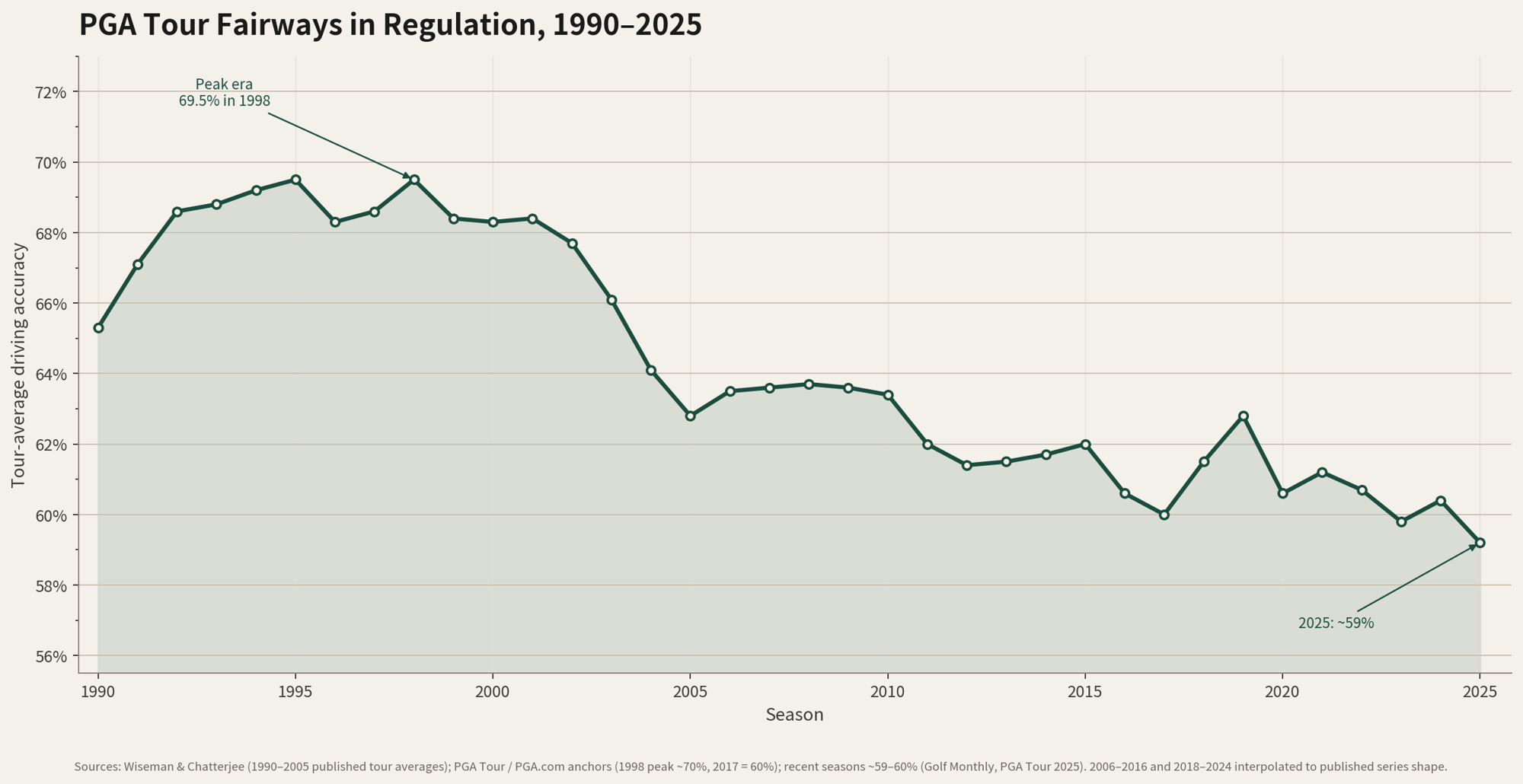
If you take away anything from this week’s post it should be this:
The true scoring comes from greens in regulation. And hitting from the fairway is not always necessary for that to occur.
Let me explain.
Have a look at this chart below:
