


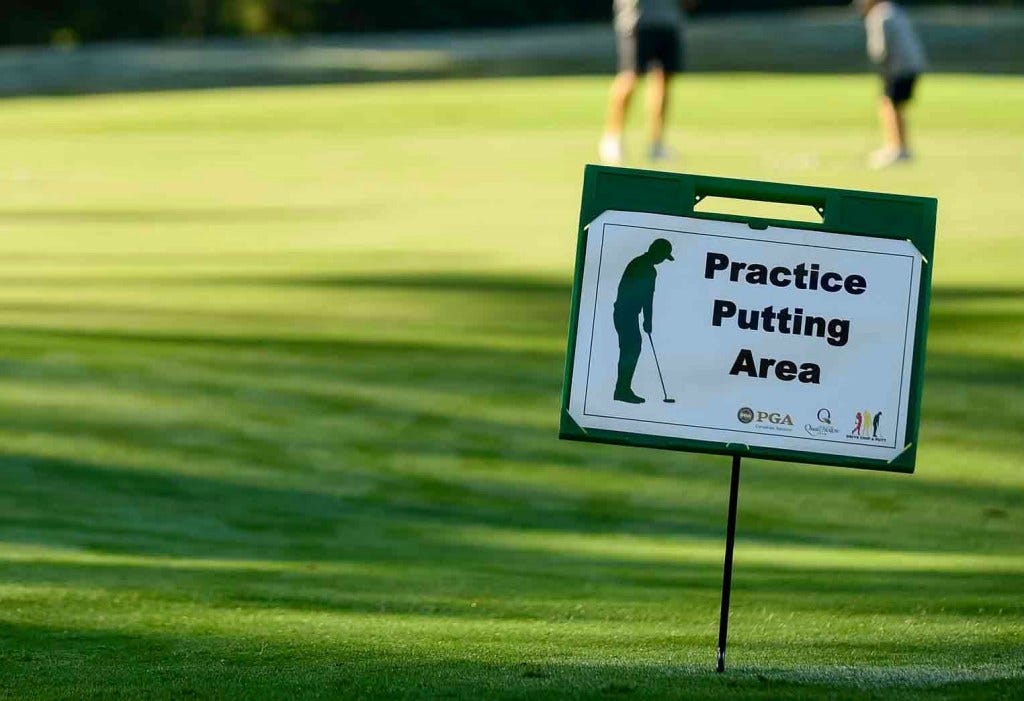
You know the drill. You show up 20 minutes early. You’re being responsible. You grab your putter and head to the practice green like a good little golfer. And for the next 15 minutes, you absolutely stripe it. Rolling in 15-footers. Draining lag putts from 40 feet to gimme range. Feeling confident. Feeling dialed in.
Then you get to the first green and promptly three-putt from 25 feet. What the hell just happened?
Here’s what happened: you just spent 15 minutes practicing something that has almost nothing to do with putting on the actual golf course. And now you’re confused why all that “practice” didn’t translate to your round.
Welcome to one of the sneakiest little tricks in golf. The idea that spending time on the practice green before your round actually prepares you for the putts you’re about to face. The reality is that it doesn’t do much more than loosen you up. Unless you practice correctly…
The Problem With How You Practice
Let’s break down what most people do on the practice green:
They grab three balls (four if you’re feeling spicy). They find a flat 10 footer. Maybe it has a slight bend to it – but probably not. They hit the same putt over and over until they make a few. Maybe hit some lag putts. Maybe work on some short ones. All very casual. All very low-stakes. All completely useless for what’s about to happen on the course.
Here’s why: there’s absolutely zero consequence. There’s no pressure. There’s no variability. You’re just… rolling balls. And subconsciously your body knows it doesn’t matter. So it’s not activating the same systems it will when you’re standing over that knee buckling four-footer moving down the hill and away from you.
And then you get onto the first green and suddenly it’s a totally different game. The slope is so much more intense. There’s weird grain you didn’t notice. There’s a slight breeze (does wind affect my ball who knows). Now there’s the fact that if you miss this putt, you have to give yourself a bogey on the first hole. And now you’re +1. And now there’s no way you’ll qualify for the US Open!!! Life can be tough.
The issue is this: You practiced rolling balls in a consequence-free environment. But golf isn’t consequence-free. Every putt matters. Every putt has context. And if you’re not practicing with that same level of pressure and variability, you’re not actually preparing yourself for the round.
What Actually Happens on the Course
Let me paint you a picture of what putting actually looks like during a round:
You hit your ball to 30 feet. You’re on a green you’ve never played before (or maybe you have but you don’t remember the exact break). There’s a severe right-to-left slope but also some grain going the opposite direction. You’re putting down the hill. Your playing partner just chipped in for a birdie and is watching you. You topped your tee shot so you’re still in your head about that. But somehow you managed to scramble your way onto the green and now you’re desperately trying to save a par. And oh ya, you only get one attempt at this putt. And if it’s a bad putt you have to putt it again coming back up the hill.
That’s real golf. And nowhere in that scenario does it resemble you casually rolling three balls at the same hole on a practice green with ZERO stakes.
So when you step up to that 30-footer on the course, your brain is dealing with:
• Uncertainty about the read
• Pressure to not three-putt
• No reference point from a previous attempt
• Environmental factors you didn’t account for
• The mental load of the round so far
And you’re surprised when you blow it six feet past and miss the comebacker? You shouldn’t be. You never practiced dealing with any of that.
The Mental Game You’re Ignoring
Here’s something maybe you haven’t considered: the difference between making a putt on the practice green and making a putt on the course isn’t technical. It’s mental.
Your stroke doesn’t magically get worse when you step on the first green. Your alignment doesn’t suddenly become trash. You didn’t forget how to read greens in the 30 seconds it took to walk from the practice area to the first tee.
What changed is the pressure. The stakes. The consequence.
On the practice green, your brain is in “autopilot mode.” You’re just rolling balls. There’s no internal monologue about what happens if you miss. There’s no scorecard implications. There’s no playing partners judging your performance. Your nervous system is chill.
But on the course? Your brain shifts into “evaluation mode.” Now every putt is being judged. Now there’s a right outcome and a wrong outcome. Now missing has consequences – bogey instead of par, lost match, ruined score, whatever.
And if you haven’t trained your brain to handle that shift, you’re gonna struggle. Because suddenly you’re not just putting. You’re putting while managing anxiety, doubt, and pressure. That’s a totally different skill. And it’s one you need to actually practice.
How to Actually Practice Putting
Ok so you’re probably thinking this all sounds obvious. Just give me the fix. How do you practice putting in a way that actually prepares you for the course?
My answer is this: You have to find a way to simulate pressure. You need to create consequence. You need to introduce variability. You need to make the practice green feel as close to the real thing as possible.
Here’s what that looks like in practice:
1. One Ball Only
Stop hitting three balls to the same hole. That’s not golf. Golf is one attempt. One read. One putt. If you miss, you’re putting from wherever it ends up.
So practice the same way. Pick a hole. Hit one ball. Read it, commit, and roll it. If you miss, you’re putting from there. No do-overs. You get one shot, just like on the course.
This forces you to treat every putt like it matters. Because it does. You don’t get a second attempt to “figure it out.” You have to commit to your read and your stroke on the first try. That’s real golf.

2. Add Consequences
Create stakes for yourself. Make it hurt a little when you miss.
For example: pick five putts from different spots around the hole. If you two-putt all five, you’re done. If you three-putt any of them, you have to start over.
Or try this: you have to make three putts in a row from 6 feet. Different holes, different breaks. Miss one and you start over at zero. Watch how nervous you get when you’ve drained the first 5 and are standing over #6 lol.
Or this: lag putting drill where you have to get five putts in a row inside a three-foot circle from 30+ feet. If one goes outside the circle, restart.
The specific drill doesn’t matter that much. What matters is that there’s a consequence for missing. Because that consequence – even if it’s just “I have to do this again” – is what triggers the same pressure response you’ll feel on the course. And that’s what you need to get comfortable with.
3. Practice Different Putts, Not the Same Putt
Stop grinding the same 10-footer over and over. You’re not gonna face the same putt twice in a round (unless you’re really bad and keep three-putting the same hole).
Instead, practice different putts. Move around the green. Hit uphill putts, downhill putts, sidehill putts. Long ones, short ones, medium ones. Different breaks, different speeds.
This does two things:
First, it forces you to read each putt fresh. You can’t rely on the feedback from the previous attempt because it’s a completely different putt. Just like on the course.
Second, it builds your library of feels. You start to develop a sense for how putts break, how much speed you need for different slopes, how grain affects the roll. That’s real putting knowledge. Not just “I made ten 12-footers in a row from the same spot.”
4. Simulate the First Tee Jitters
Here’s a sneaky one that most people don’t think about. It’s a little dorky so if you do this one, maybe go do it in private so no one makes fun of you. But you should try to practice putting when you’re amped up.
This means do some jumping jacks. Sprint to the practice green lol. Get your heart rate up a bit. Then immediately putt.
Why? Because on the first tee, you’re gonna have some adrenaline flowing. Your hands might be a little shaky. Your breathing might be a little faster. And if you’ve only practiced putting in a completely calm state, you’re not gonna know how to handle that elevated physiological response.
Practicing while slightly amped teaches your body to make a smooth stroke even when your nervous system is activated. And that’s a game-changer for those first few holes when the jitters are real.
Why This Actually Works
The reason this type of practice works is because it trains the thing that actually matters: your ability to perform under pressure with incomplete information and no do-overs.
Technical putting skill is important, obviously. You need a decent stroke. You need to be able to read greens at a basic level. But once you have those fundamentals down, the difference between good putting and great putting isn’t mechanical. It’s mental.
Can you commit to a read even when you’re not 100% sure?
Can you make a smooth stroke when your hands are a little shaky?
Can you handle the pressure of a must-make putt without getting in your own head?
Those are the skills that determine whether you roll in that par-saver on 18 or blow it three feet past and make bogey. And you can’t develop those skills by casually rolling three balls at the same hole on the practice green.
You develop them by simulating real golf conditions. Pressure. Variability. Consequences. One attempt.
Do that for 10-15 minutes before your round and you’ll actually be prepared for what’s about to happen on the course. Instead of just warmed up on putts that don’t exist in real golf.
Because unfortunately most practice doesn’t transfer because most practice doesn’t resemble the thing you’re trying to get better at.
If you practice free throws in basketball by shooting with no defender, no clock, and no game situation, how much do you think that helps when you’re at the line in the fourth quarter with the game on the line? Not much. Because the skill you need in that moment isn’t just “make a free throw.” It’s “make a free throw under extreme pressure while exhausted.”
Same thing with putting. The skill you need on the course isn’t “roll a ball into a hole.” It’s “read a putt you’ve never seen before, commit to that read with limited information, and make a smooth stroke under pressure knowing you only get one attempt.”
That’s a way more complex skill. And if you’re not practicing that specific skill, your practice isn’t gonna transfer.
A Quick Note on Green Speed
One other thing that screws people up: the practice green often doesn’t match the course greens.
Maybe the practice green is slower because it gets more traffic. Maybe it’s faster because they mow it differently. Maybe the grain is different. Maybe the slope is less severe.
Whatever the reason, if the practice green doesn’t putt the same as the course greens, all that practice is teaching you the wrong speed. And speed is like 80% of putting.
So here’s what you do: when you get to the first green, forget everything you learned on the practice green about speed. Treat it like you’re putting on that surface for the first time. Trust your eyes. Trust your feel. Don’t try to force the stroke you were making on the practice green if the speed is clearly different.
Final Thought
The practice green isn’t useless. But the way most people use it is.
If you’re just casually rolling balls with no pressure, no consequences, and no variability, you’re not actually preparing yourself for the round. You’re just… warming up your muscles I guess. Which is fine. But don’t expect that to translate to better putting during your round.
If you want your practice to actually matter, you need to practice like you play. One ball. Real pressure. Consequences. Different putts. Make it uncomfortable. Make it hard. Because that’s what putting on the course actually is.
And look, you’re still gonna three-putt sometimes. That’s golf. Even tour players three-putt (just nowhere near as much as we do). But if you practice the right way, you’ll three-putt way less. You’ll make more of those four-footers under pressure. You’ll lag it close more often. You’ll feel more confident standing over putts that matter.
That’s the goal. Not to never miss. But to be better prepared for the putts you’re actually gonna face when the round starts and it actually counts.
So next time you show up early and head to the practice green, don’t just roll balls around aimlessly. Create some pressure. Add some consequences. Practice one-ball putting. Simulate the real thing.
Because the putting green lie is thinking that any practice is good practice. It’s not. Only the right kind of practice actually transfers to the course.
Stop lying to yourself. Start practicing putts that actually matter.