


When I first started playing golf, I did what pretty much every golfer does.
I grounded the putter.
I put the sole behind the ball, saw my line, started my stroke. Nothing technically wrong with it. It’s what the guy ahead of you does. It’s what the guy behind you does. It’s what most of the guys on Tour do. It’s the “correct” thing to do.
But still, I kept mis-hitting putts. The putter head would get stuck to the ground during the takeaway and cause major inconsistencies in my stroke. And once I started feeling it, I started anticipating it. And that is the worst thing that can happen to a putting stroke. The moment your attention shifts from executing the putt to managing a flaw in the setup, the ball becomes an afterthought.
Lag putts were fine. Distance control, green reading. No issues there. But inside of five feet? I was sweating.
I genuinely did not know what the putter head was going to do when the stroke began. Those putts are supposed to be automatic. They are not automatic when you’re standing over the ball wondering whether your takeaway will behave itself.
Something had to change.
The Problem
My takeaway felt sticky. It felt like my stroke had to solve two problems simultaneously before it could actually begin. The putter had to first lift off the ground. And then it had to start moving backward. Somehow both at the same time?
It was a strange feeling that the stroke had to break free before it could truly flow. Like how in the hell do you begin the inertia of a putting stroke from being totally still?
Once I noticed it, I couldn’t stop noticing it.
What Do The Pros Do?
So I did what all great amateurs golfers do when the wheels come off.
I consulted YouTube for confirmation bias.
I wanted to know that my putting woes weren’t unique, and that millions of other amateurs struggled alongside me.
But what I found was even better. It turned out many PGA pros hover the putter for this exact reason!
Rickie Fowler is one of the most prominent examples of someone who hovers his putter, and he’s explained it in detail during interviews. He adopted the habit to avoid the putter catching on the ground during the backstroke, which helps release tension and leads to a more fluid motion. In a 2017 Golf Digest article, he said: “The other lightness is hovering my putter just above the ground before I start my stroke. When the putter rests directly on the grass, it has a tendency to snag on the way back.”
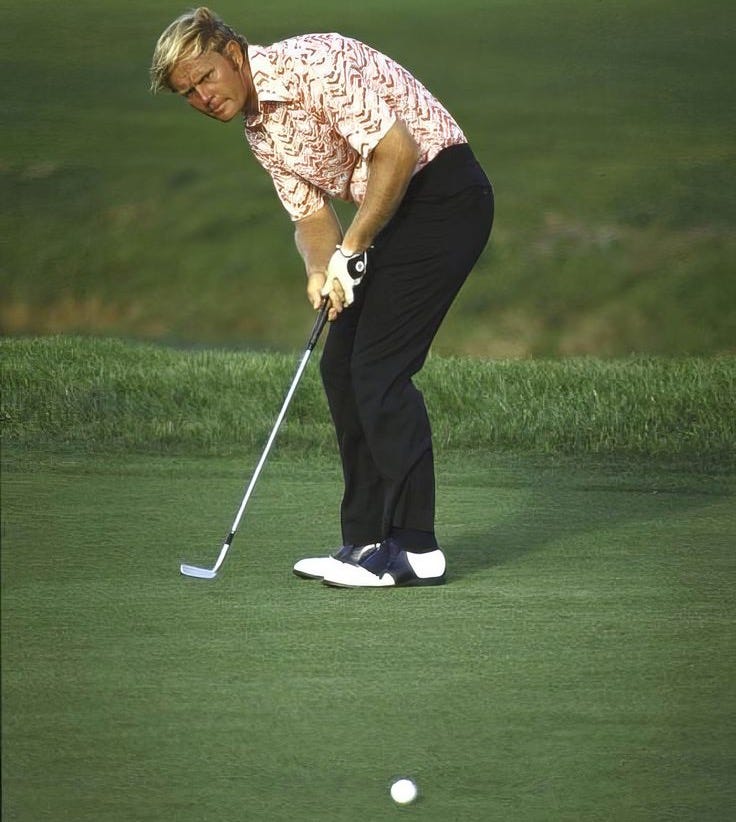
Here is a close up of him doing it.
The legendary Jack Nicklaus has long advocated hovering not just the putter but all clubs. He started it partly to avoid penalties if the ball moved at address, but kept it for its benefits in maintaining grip firmness and reducing excess tension.
Even Greg Norman has said ““By hovering the club, you not only eliminate that risk [of regripping], you reduce the tendency to snag the club face in the grass, both on the takeaway and on the way down to the ball.”
Hideki Matsuyama does a version of the same thing — a small tap or bounce before initiating the stroke. Essentially unweighting of the club. In the video below it does look as though the putter is hovering before the takeaway.
So I Started Doing It
My stroke felt immediately smoother. The putter went from feeling like a door you had to pull open to a pendulum already in motion. It didn’t have to break free from anything. It simply began.
But there was a second discovery — one I have since become obsessed with.
Every great putter has a trigger.
Some small, repeatable action that tells the body: now. Jordan Spieth has his famous shaft lean forward before the stroke begins. The trigger removes the decision of when to start. The stroke doesn’t begin because he manipulated or willed it to begin. It begins because the trigger fired.
The hovering of the putter face didn’t just eliminate the possibility of the club dragging on the ground, it also created my new “trigger”. Which then allowed me to become more rhythmic and consistent in my stroke.
Should You Do It?
This is not a universal prescription. I want to be clear about that.
Some golfers find genuine stability in grounding the putter. They like a visual anchor, a face-alignment reference, a feeling of the putter being settled at address. For those players, hovering might actually cause tension rather than relieving it.
Some mallet designs are specifically engineered to sit square at the sole, meaning that lifting the head even slightly can alter the face angle in ways that create new problems.
Putting is deeply personal. The stroke that freed me may feel like chaos to you.
Test It
Maybe your putting is fine. Maybe it isn't. But if you’ve never attempted to hover it before address, just try it out and see what you think.
Find a straight five-footer. Hit two sets of ten balls.
First set: putter fully grounded. Note how the stroke initiates. Note how consistent the start-line is.
Second set: hover the putter just above the grass. Do not overthink the height. A millimeter is enough.
Pay attention to two things only: how the stroke feels at initiation, and how reliably the ball starts where you aimed it.
Most golfers feel the difference within a few putts. Some will prefer what they already had.
There’s no correct answer. Just your own personal experience and preference.
Final Takeaway
I did not hover the putter because someone told me to. I hovered it because a problem in my own stroke eventually demanded an answer, and this was the answer that fit.
What I learned is simpler than any technique:
The first milliseconds of the stroke matter more than most golfers ever consider. The transition from stillness to motion is not neutral. It is the origin of everything that follows.
Hovering the putter is one way to make that origin “cleaner”.
For me, it worked. The stroke is quieter. The short putts feel less consequential. The trigger is automatic.
So try it out, or don’t. Putting is about finding your hover or trigger, and then relentlessly perfecting it.
If you have any unique putting swing thoughts or triggers, share them below. I’d love to hear what they are, and maybe they will resonate with some of our readers.
Until next time,
Tommy
PDF Guides: Are available by clicking here for paid subs
Social Media: Make sure to follow me on X here.
Here what has helped me with short putts.
Setup to the ball.
Focus on the spot where you want the ball to fall into the hole (left side / center / right side).
Then see the imaginary line from that spot back to the ball.
Then focus on the spot on the ball you want to hit so it will follow that line, and hit that spot with the center of the putter face.
I think we all know to do this but we only do it subconsciously, but by doing it consciously, it forces you to slow down and focus. You’re not thinking mechanics, you focused on the details of the putt itself.
Hole —> Line --> Ball…. then go
I tried lots of things in terms of grip styles and putter types.
Biggest thing for me was getting properly fitted. Now when I miss putts I know it's most likely a misread or hit at the wrong pace.
Confidence makes all the difference when you are hovering over a putt