



Happy Sunday everyone.
Let’s get into it.
Today’s quote:
“Discipline and concentration are a matter of being interested.”
— Tom Kite
Distance or Accuracy?
Who would you choose in a match?
Player A: drives the ball 200 yards and dead straight.
Player B: drives the ball 300 yards but is wild off the tee.
This question comes from @DivotDoctrine on X who posted the below argument:

Is he correct?
The answer won’t surprise you if you’re familiar with strokes-gained data. But if you’re not familiar, I will hand it over to Arccos’ lead data analyst, Lou Stagner, to reveal the truth
Stagner was quick to reply to (and correct) the original post.


Since Substack cuts off the tweet earlier, here was what Stagner replied:
Of all the male golfers that average about 200 yards off the tee, I took the most accurate 5% of players from that group. I compared those short hitters to players that hit it about 300 yards off the tee, and I used the least accurate 10% of players from that long hitting group.
It wasn't even close.
Median Handicap Index:
▶️200-yard straight players: 11.3
▶️300-yard wild players: 5.1CONCLUSION:
▶️The 300-yard player will have the better index 81% of the time.
▶️That means the 300-yard player is the better player 8.1 out of 10 times.
Maybe not the clearest “apples to apples” comparison, but strokes-gained data is pretty clear on this:
Hitting the ball further even if it puts you in the rough is generally more beneficial.
Obviously if there are hazards or OB, that changes the equation. But if there is no penalty risk, the data says to grip it and rip it.
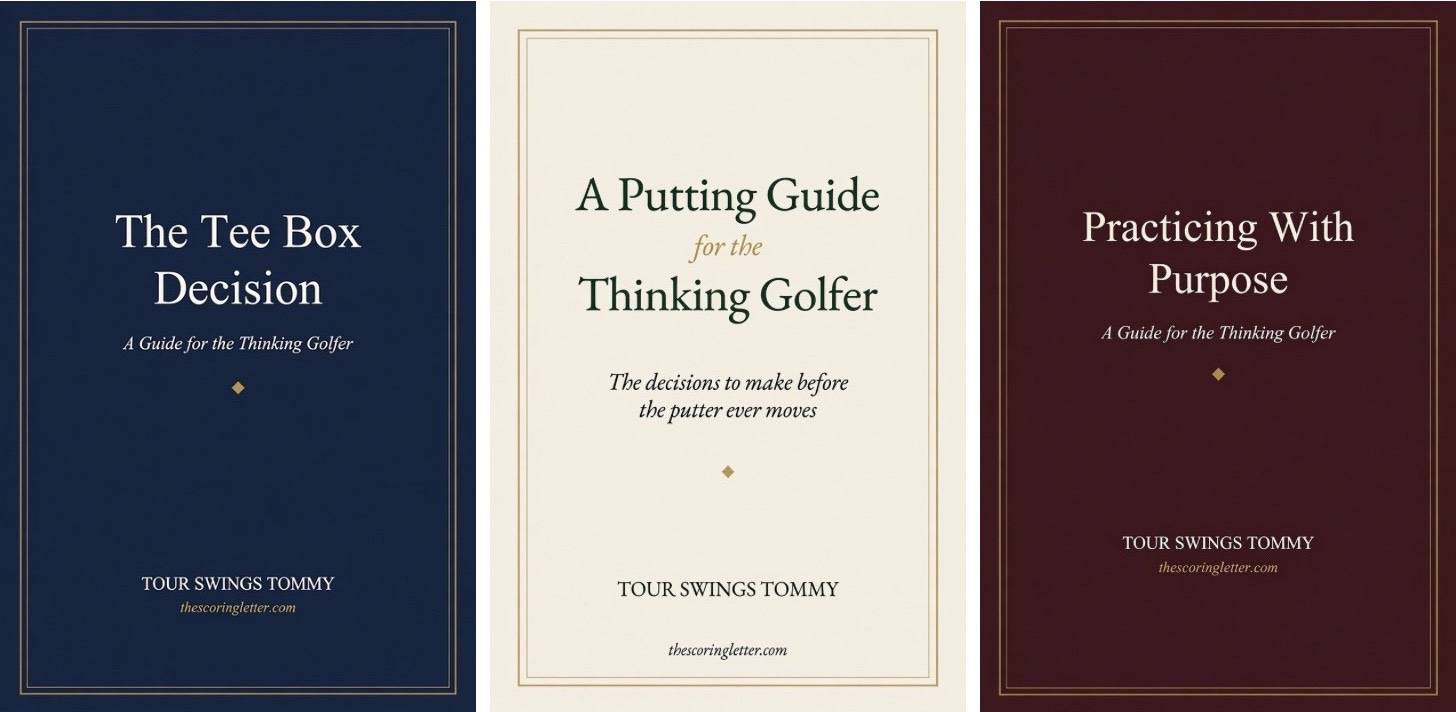
Featured Guides
Free for premium subscribers here
Tiger’s Tactics
I don’t often share golf stories, but this one was too good not to pass along.
Subpar is a golf podcast hosted by former PGA Tour pro Colt Knost. Last week the podcast spoke with another former PGA Tour pro, Brendon De Jonge.
In the episode, De Jonge shared what it was like the first time he got to experience playing in the final Sunday threesome with Tiger.
He described a crowd unlike anything he had ever seen. But the part I thought most fascinating, and why I wanted to share this, was how Tiger allegedly used his massive galleries to his advantage.
De Jonge says:
“I remember this so vividly, that for the first nine holes, he would putt it up there to about a foot away from the hole, and he’d mark, and he’d wait, because he knew as soon as he taps in everyone is going to take off [to the next tee]. He would mark, he was very courteous, he would let us try and putt. As soon as we got to No. 10, he putted up to a foot away, he’d walk up there and tap it in. As soon as he taps in, sure enough everybody takes off running. So you are standing over your putt and you are looking up, looking up, and all you see is just moving bodies all over the place. He played the game that day — he’d been in that position so many times he knew exactly how to use it to his advantage.”

I guess there are levels to this game…
Greensides in Regulation
You’ve all likely heard of greens in regulation and fairways in regulation. But you probably haven’t heard of "greensides in regulation". That’s because it was invented last week by Golf Digest writer Sam Weinman.
Weinman recently wrote about one of his best rounds of the year. He realized that while he didn’t hit many greens in regulation, he consistently left himself simple, stress-free chip shots from just off the green to save par. So he decided to create his own stat called "greensides in regulation" to track how often he gets his approach shots into this comfortable scoring zone.
Weinman explains:
You're either on the green, or you’re at least close enough to chip it on and potentially save par. For mid-handicappers like me who don’t count on a lot of birdie putts, it’s probably the best indicator of a decent score, and in my case, it was.
It’s an interesting concept and a great perspective shift in course management. Good golf is about good misses. And a good greenside miss is one that leaves you with an easy recovery, such as an area with a clean lie, plenty of green to work with, an uphill chip instead of a downhill one, etc…
Pay attention during your next round to how many manageable greenside spots you actually hit. You might be surprised to find how often you are leaving yourself in positions where scrambling is impossible.
Playing well is missing well.
That’s it for today. Hope you all have a great week and get out and play!
If you have any questions, comments, or feedback, please don’t hesitate to email me at tourswingstommy@gmail.com. I read everything.

You can pre-order the digital version of my new book on Amazon HERE.
Social Media: Make sure to follow me on X here.
If you haven’t read them yet, check out some of the most popular Scoring Letter posts below:


