


I love chipping. It’s by far my favorite part of the game. Mostly because it’s the one area where feel and artistry truly can shine. Another great thing about it is that it’s entirely free to practice!
Smashing driver at the range is fun, don’t get me wrong. But if you’re like most people, you don’t really enjoy spending $16 on a bucket of balls every time you want to practice (yes it’s gotten insane).
Lucky for you, chipping is of equal importance as your driver, and you can practice it entirely free! For as long as you want! And no one can stop you.

Not only do I want to encourage you to spend more time practicing your chipping, I want you to practice chipping in a way that actually translates to the course.
Because let’s face it, your chipping practice probably looks like this: you grab one wedge (your 60 degree most likely), drop a pile of balls, and start chipping from the same spot over and over again. Maybe you decide to get freaky and move the ball to the opposite side of the practice green. You hit a few close, maybe even hole one out. Yay. Time to leave.
Then the next time you get on the course you blade your first chip 30 feet past the hole and chunk the next one.
What the hell happened? You spent an hour practicing your chipping yesterday!
Here’s what happened: your practice doesn’t look anything like the golf you actually play.
You practiced from the same perfect lie. Same distance. Same trajectory. No consequences. No decisions to make. Just mindless reps aimed at a flag that you’re not even really trying to get close to because there’s ten more balls in the pile anyway.
That’s not practice. That’s just hitting balls. There is a difference…
The Problem With How We Practice Chipping
Most golfers practice chipping like they’re on a driving range mat. Stand there. Hit ball after ball from the same spot. Move on when they get bored of the club.
No scoring. No pressure. No variety. Just reps.
If you want your short game to actually hold up on the course, your practice needs three things:
Consequence - Every shot needs to matter. If you can just shrug and grab another ball, you’re not learning how to handle the pressure of needing to get up and down.
Variety - On the course you’re not hitting the same chip ten times in a row. You’re hitting from different lies, different slopes, different distances.
Realism - The shot you practice needs to be the shot you’ll face. Standing in the middle of the practice green with a perfect lie? That’s not real golf.
So let me give you three games that fix this. You can do all of them by yourself. No cones, no alignment sticks, no stupid training aids. Just you, your wedges, and a practice green.
1. Par 18
If you only play one chipping game for the rest of your life, make it this one.
Par 18 is the gold standard. It’s what tour pros do. It’s what scratch golfers do.
Here’s how it works:
Pick nine different spots around the practice green. Mix it up - some easy chips, some harder ones, different lies, different slopes. Each spot is a “hole.” Chip it and then putt out. The goal is par 2 on every hole - one chip, one putt. Just like a real up-and-down.
If you get it up and down, you made par. If you two-putt, you made bogey. If you blade it off the green and then three-putt, you just made a 5.
Your goal is to finish all nine holes in 18 strokes or fewer. That’s even par. Very very difficult to do.
And yes, I understand not everyone is able to do this. Some practice greens are destroyed from pitch marks and not good to putt on.
If this is your green, then I still have other games for you. Keep reading.
What This Game Teaches You
Par 18 isn’t about technique. It’s about converting.
You can hit the most beautiful chip that lands soft and checks up. Looks like a tour shot. But if you don’t make the putt, you just made bogey. The shot doesn’t matter if the score doesn’t reflect it.

Par 18 trains this ruthlessly. Every chip is immediately followed by a putt that you HAVE to make to save par. So you start actually caring about where your chip finishes.
After you’ve played Par 18 a few times, you’ll start noticing patterns. “I always leave this uphill chip 6 feet short.” Or “I keep pulling my chips from this downhill lie.” That’s real feedback you can use to actually improve.
Track your score. Write it down. Come back next week and try to beat it.
2. Darts - Distance Control
Most amateurs miss chips long or short way more than they miss them left or right. Distance control. Or lack of it. The Darts game aims to improve this.
Here’s how it works:
Pick a hole. Hit a series of chips from different spots around the green. After each chip, score it based on how close you got:
Inside 3 feet = 3 points
Inside 6 feet = 2 points
Inside 10 feet = 1 point
Outside 10 feet = 0 points
You can add bonus points for holing out. Just don’t pump your fist or anything in case someone sees you.

No cones needed. Just pace it off. Hit 10 chips. Add up your score. Try to beat it next time.
What This Game Teaches You
Darts trains you to think in terms of where your chip actually finishes and not technique or contact. Which don’t get me wrong - that’s important. But at the end of the day, your job is getting the ball to stop where you want it to.
You stop thinking “I need to hit a good chip” and start thinking “I need to finish this inside 6 feet.” That’s a huge mental shift.
You start noticing how different trajectories affect rollout. You start seeing that a lower bump-and-run might actually stop closer than a high flop shot from certain lies. You start understanding landing spots better.
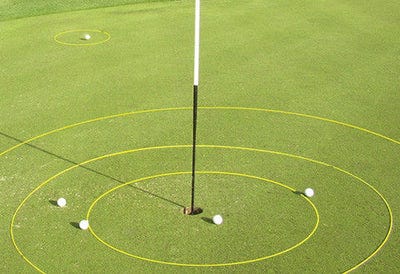
This game also exposes your weaknesses fast. If you’re consistently scoring 0s and 1s, you have a distance control problem. And distance control comes from practice where you’re trying to hit targets.
3. One Shot, Three Clubs
Most amateurs chip with one club. Usually a 60 degree. That’s fine when you’re a higher handicap. And I’m not against mastering one club. I did write about doing that here.
However, the problem is this: there are times when a high lob wedge is the absolute worst club you could use. But you don’t know that because you’ve never practiced the alternatives.
Here’s how it works:
Pick one chipping scenario. Now hit that same chip three times using three different clubs:
High option - 60 or 58 degree (soft landing, less rollout)
Mid option - Pitching wedge or 52 degree (medium trajectory)
Low option - 9 iron or even 8 iron (low bump-and-run)
Same target. Same landing idea. Different tools. Whichever ball finishes closest “wins.”
Repeat this from different lies and slopes around the green.
What This Actually Teaches You
This game teaches you that there are multiple solutions to the same problem. And some solutions are more correct or “better” than others.
Most amateurs default to their 60 degree for everything. And I get it. I do the same thing (I’m trying to stop). But from a tight lie with 30 feet of green to work with? A 60 degree is overkill. A pitching wedge bump-and-run can be a way safer play and will probably finish closer. But you don’t know that unless you’ve actually tried it.
This game also trains you to think about trajectory and rollout. A 60 degree might check up in 3 feet. A pitching wedge might release 10 feet. An 8 iron might roll out 20 feet. You need to know this stuff from experience.
Why It Transfers to the Course
On the course, you don’t get three attempts. You get one. And the difference between shooting 82 and 79 is often just making better club selections around the greens.

I can’t tell you how many times I’ve seen guys try to flop a 60 degree from a tight lie when a simple bump-and-run with a 9 iron would’ve been automatic. That’s not necessarily a skill problem. That’s a decision problem.
This game builds the experience and confidence to make better decisions.
Final Thought
If your short game practice doesn’t include scoring, variety, pressure, and decision-making... you’re lying to yourself about actually improving.
Pick one of these games. Play it seriously. Track your results. Write them down. Come back next week and try to beat your score.
That’s how you actually get better. Not by hitting a thousand chips into the void. But by playing the game and keeping score and trying to win.
Your chipping won’t just improve - it’ll hold up when it matters. Which is the only time it actually counts anyway.
PDF Guides: Are available by clicking here for paid subs
Social Media: Make sure to follow me on X here