


Howdy fellow golf fanatics.
Hope you’re having a nice start to your week. The Scoring Letter has gained quite a bit of new subs over the past couple of weeks, so I figured a good free post would serve as the proper welcome.
I’ve been spending time brainstorming new and creative content to produce for you all, and after some thought, I’m excited to say I’ve landed on something I think will be just as fun to read as it is to write.
It’s going to be an occasional series called Lessons From a Vintage Golf Magazine.
The idea is pretty simple: dig up golf instruction from an old school magazine and hold it up against the game today.
True to Scoring Letter standards, these won’t be swing tips per se (although some of the content does lightly touch on it). The primary focus is on how older golfers approached the game — and what we can still learn from them. Because despite all the advances in golf tech and equipment etc, the core objective of the game has remained the same: put the ball in the hole in the least amount of strokes.
The series will be for premium subs only going forward, but I’ve decided to post the first one for free today.
If you like it and want to upgrade, I’m running a little promo where you can get 30% off your first year HERE.
Ok no more plugs, let’s get into it.
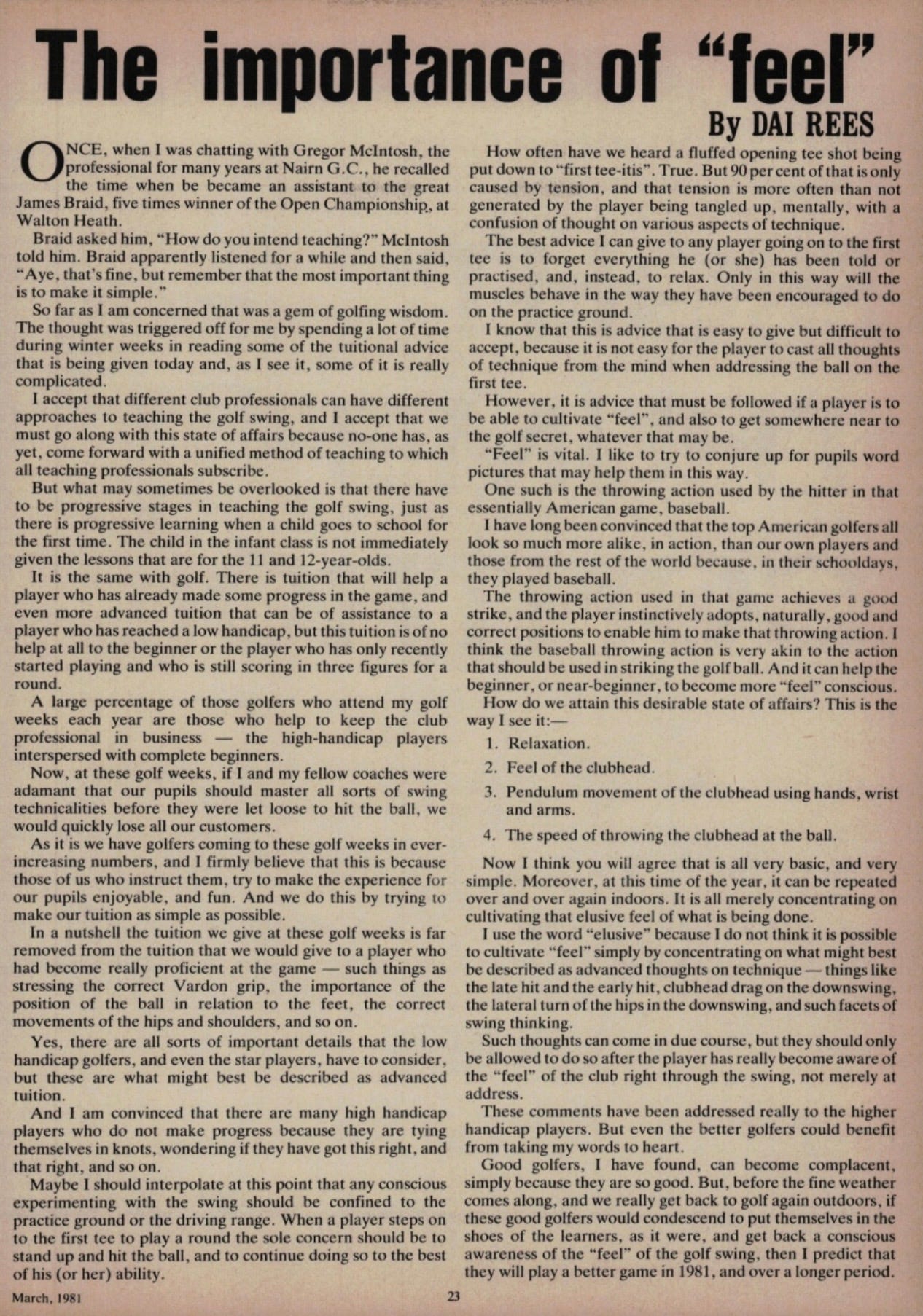
For the first entry of my new series, I decided to start with a 1,200-word column from the March 1981 issue of Golf Monthly titled The Importance of Feel.
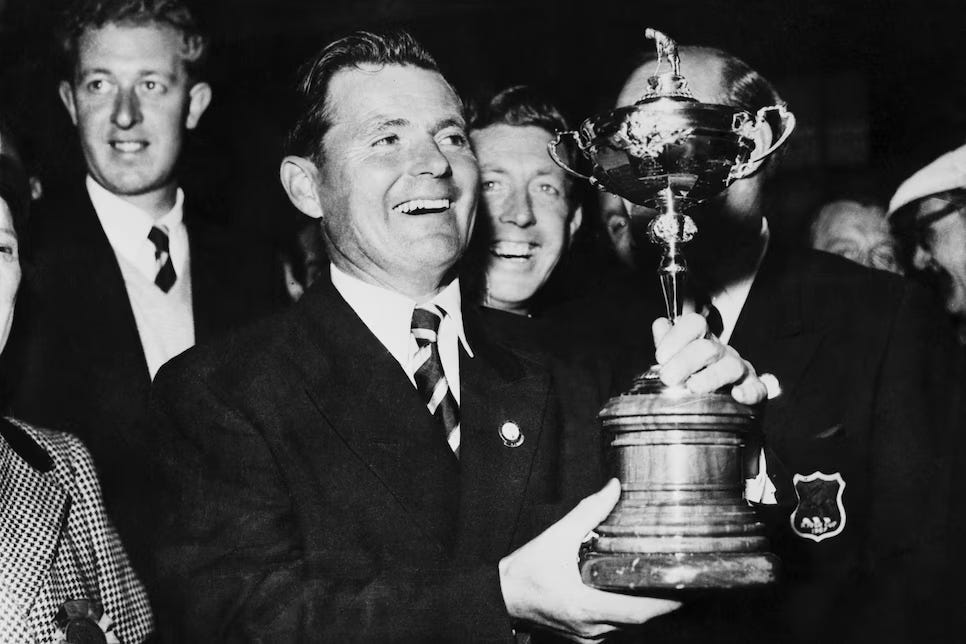
The column was written by Dai Rees — a Ryder Cup captain, nine-time Welsh PGA champion, and one of the most respected players of his era.
His words are 45 years old, yet remain devastatingly relevant today.
If you want to read the original column, I’ve attached the image below.
Paralysis by Analysis
Rees had been observing the instruction of his day and arrived at a conclusion that has only grown more true with time: golfers don’t struggle because they don’t know enough. They struggle because they know too much of the wrong things at the wrong time.
He watched it constantly. Players walking to the first tee juggling dozens of technically valid swing thoughts in their head, yet all of them completely useless the moment a shot actually needed to be hit.
His verdict was simple: high handicappers fail to improve not because they lack instruction, but because they are, in his words, “tying themselves in knots”.
I feel personally attacked by Dai Rees…
Make it Simple
Rees opens with James Braid, five-time Open Champion, being asked how he would teach the game. Braid’s answer was three words.
“Make it simple.”
Not build a comprehensive swing system. Not teach technical positions. Not optimize sequencing in the downswing. Just… make it simple.
If you’ve ever found yourself in that lowly position — hunkered down in a dark room, hunched over a laptop, clicking through shallowing drills at midnight — you already have learned that every force in modern instruction pulls in the exact opposite direction of “making it simple.”
That’s not to say you don’t need swing thoughts or drills. You do. But how many do you actually need?
It does feel like the more you try, the more complicated it gets. And the more complicated it gets, the more you try. And on and on…
What does Rees mean by “Feel”?
He divided feel into four things: relaxation, awareness of the clubhead, a pendulum motion of the arms and hands, and the sensation of throwing the clubhead at the ball.
No positions. No checkpoints.
In the column, he seemed to be pretty deliberate about one word in particular:
Elusive
He stated that feel is elusive for a very specific reason: you cannot cultivate it by concentrating on technical thoughts.
He argued that “feel” and “analysis” are mutually exclusive in the golf swing.
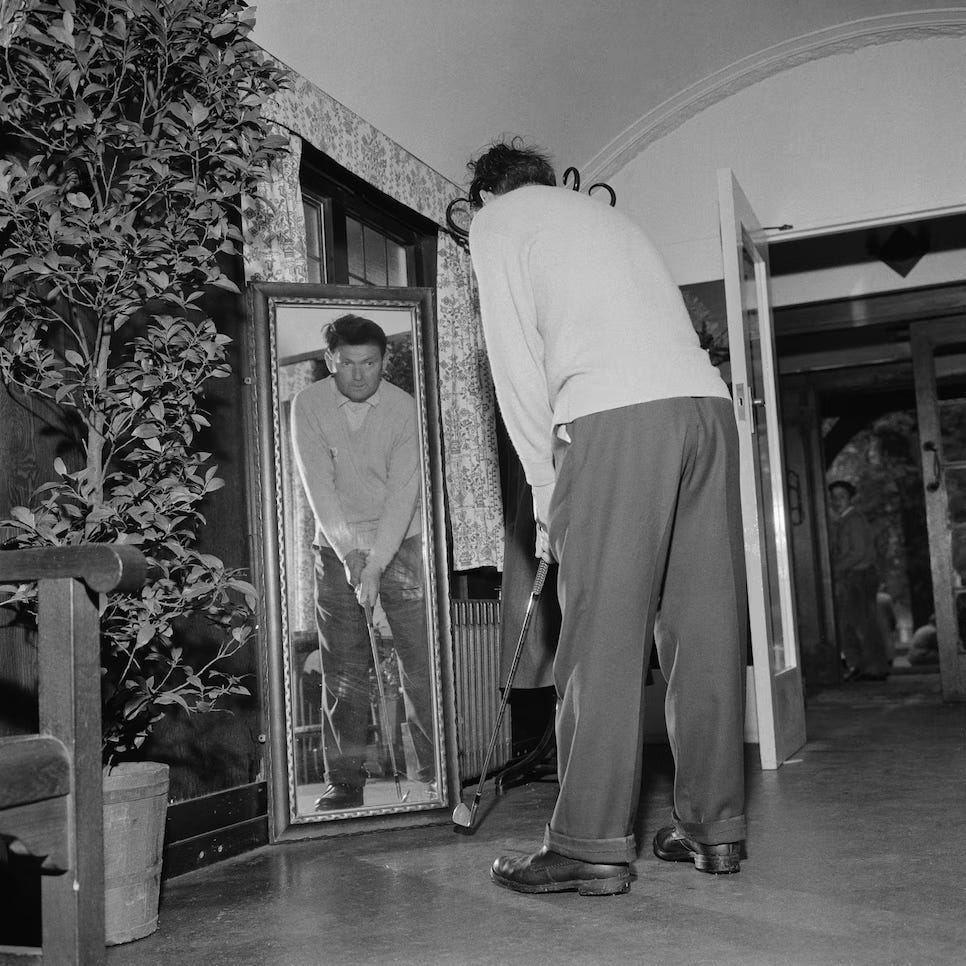
The second you shift your attention to something more technical like club path or hip sequencing, or whatever math equation you’re solving in your head, you’ve effectively lost feel. Instead, you’ve replaced it with analysis. The two cannot coexist.
His argument was that you cannot play golf thinking about positions. You can play golf by feeling motion.
I don’t totally disagree. I have found that both sometimes work for me. But let’s continue.
The Baseball Analogy
This is the part of the piece that interested me most, and the part I suspect will linger in your mind after reading this.
Rees argues that the throwing action in baseball naturally produces good positions — and that the mechanics required are nearly identical to what’s needed in a golf swing.
His prescription for beginners: use that throwing sensation as your mental model. Let it make you more feel-conscious rather than position-conscious.
Here’s the really interesting part. He observed that top American golfers of his era had a uniformity in their swings that their British counterparts lacked. He attributed it to baseball being baked into their childhoods. They’d spent years developing an athletic throwing motion before they ever picked up a golf club. The feel was already there. The golf swing had something natural to attach itself to.
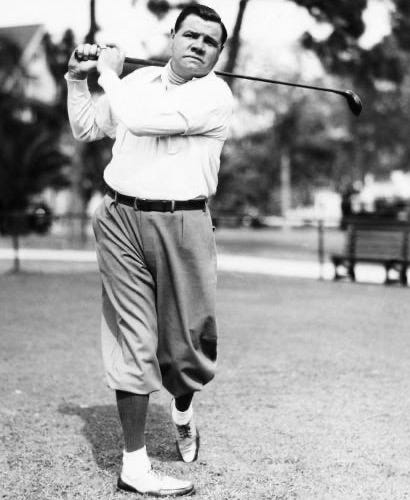
In an era where we hand beginners a launch monitor and some sort of shallowing gait belt on day one, we’ve essentially stripped out the athletic intuition Rees was pointing to.
The First Tee Problem
Every golfer knows this feeling all too well... You’ve been striking it beautifully on the range. You step onto the first tee. Then all of a sudden everything goes to shit…
What just happened?
Rees’s diagnosis: Mental congestion — too many thoughts running simultaneously, crowding out the natural motion you actually possess.
His remedy? The golf equivalent of some sort of hippie essential oils — forget everything, relax, let the swing happen.
But this only works if you built your game around feel in the first place. A swing built around positions has nothing to fall back on when pressure arrives.
Unfortunately you can’t think your way through a golf swing under stress. But according to Rees you can feel your way through one…
Fast Forward to Modern Golf
If Rees thought 1981 instruction was overly complicated, the current landscape would cause his head to explode.
Launch monitors. Face angle. Club path. Attack angle. An infinite supply of video breakdowns dissecting positions frame by frame.
None of this is inherently useless. For the record I think data can be invaluable. But most golfers are using it backwards — building from data first, instead of building feel first and using data to refine it afterward.
The result is that they become hyper-aware of everything, yet capable of executing nothing.
Did technology fix amateur golf? Or did it give confused players more sophisticated ways to stay confused.
How Feel Actually Shows Up in Your Scorecard
I understand how talking about feel can be kind of abstract and intangible. So let me give you a few concrete and tangible ways in which feel shows up in your golf game.
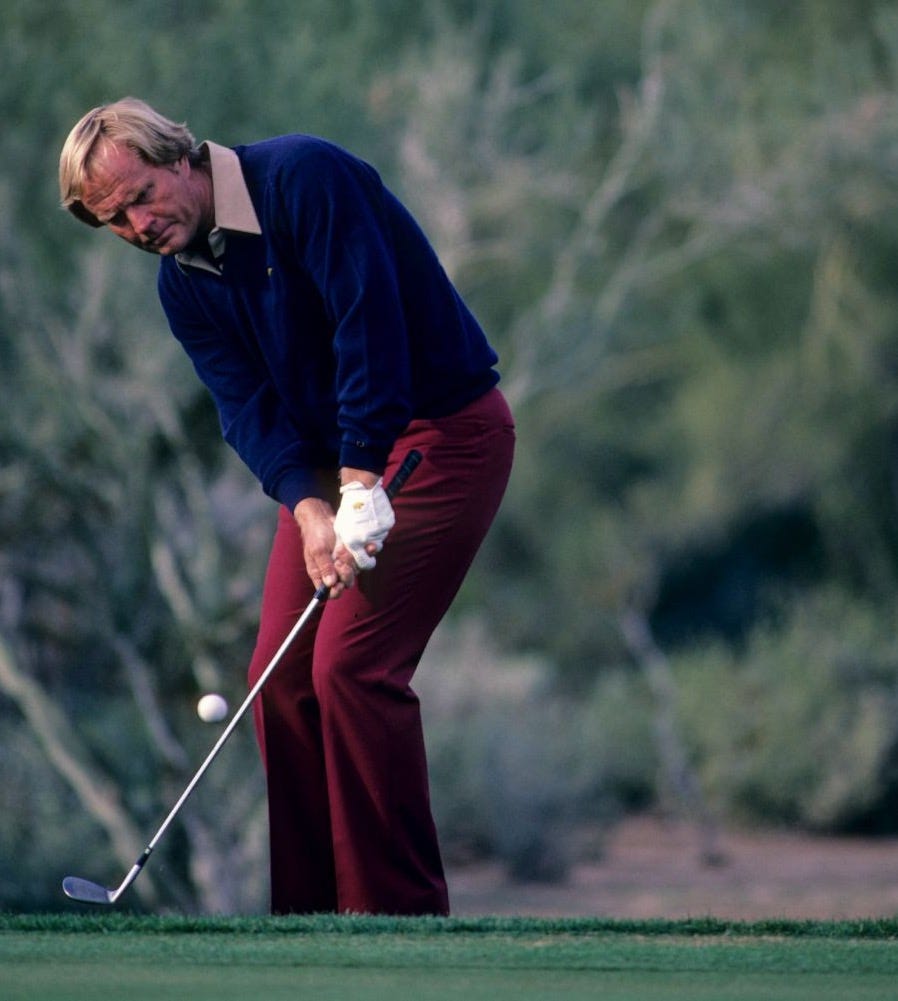
Distance Control. You can’t always hit wedges with mechanics. You sometimes need to hit them with feel.
Short Game. There is no spreadsheet for how a chip comes off the face.
Putting. If you don’t think great putters have great feel, then you haven’t been playing long enough.
Tempo Under Pressure. Natural athletic feel can become a great fall back option when swing thoughts lead you astray under pressure.
What Rees Thought About Practice
Rees made the point: Practice is for thinking about the golf swing. Playing is not.
Most golfers, along with myself, are guilty of doing the exact opposite. We mindlessly beat balls on the range (the auto-pilot often times leading to great ball-striking) and then overthink every shot on the course.
The correct inversion: On the range: explore, build, think. On the course: trust, react, simplify.
Final Takeaway
Make it simple. Not because the swing is simple — it isn’t. But because playing golf demands simplicity. You can study complexity. You cannot perform it.
The average golfer today has more access to instruction than any generation in history. More video. More data. More coaching. And yet most of them feel less natural over the ball, think more during the swing, and trust themselves less than they ever have.
Dai Rees understood in 1981 what most golfers are still working to learn today: golf is not played by perfect mechanics. It’s played by a body that knows what to do — and a mind disciplined enough to get out of the way.
Hope you’ve enjoyed the first post in this new series. I’d love to hear your feedback. Did you like concept? Should I do more? Please let me know below.
Until next time,
Tommy
Social Media: Make sure to follow me on X here.
New subscriber here. This post, as well as "Aim small, miss small" have been incredibly helpful. I'm two years working with an instructor, all on a Trackman indoors. He used a lot of "feel" language combined with data - attack angle, club path, etc. The combination has taken me from a 12 index to a 9. I am now progressing toward a heavy reliance on "feel"; my only regret is that it took me into my 70's to get here!