


Golf tech has been moving at a rapid pace. We now have TrackMan bays at local facilities. SkyTrak in your buddy’s basement. Full Swing projecting Pebble Beach onto drywall. It’s gotten out of hand — in the best way possible.
With just a few hundred bux, you can pretty much get all the same data from a launch monitor that used to be restricted to the very best in the world.
The question worth asking though, is how valuable is this data to regular golfer like you and me. Is the golfer who logs three simulator sessions a week in January genuinely better by April? Or is he just better at simulator golf?
That is question I hope to have answered by the end of this.
The Good and The Bad
I don’t think anyone is pretending that having access to a simulator wouldn’t help you in some measurable way. However, I do think that their usefulness to the average golfer is maybe overstated.

If you know how to use them and what you’re looking for in the numbers, they can be a fantastic tool. But at the end of the day, golf is a game where emotion, consequence and decision making end up being where a lot of rounds are lost.
So let’s go through what simulators do well, and what they don’t do so well.
The Good
They are Objective
A simulator won’t flatter you like your buddy will. If you hit a toe-draw down the center of the fairway, your playing partner might give you the “good drive”, but was it really?
That’s where sims can be of massive benefit. Face angle, club path, spin rate, attack angle, you name it. They show you exactly what happened, not what you felt happened.
Unless you’re a low single digit or better who truly understands their swing, you’re probably guessing in your self diagnosis at the range. On a monitor, you know for a fact that your face was three degrees open and your path was four out-to-in. That’s a shorter learning loop. This potentially saves you hours upon hours of reinforcing the worst habits.
Always Accessible
No bad weather. No backed- up tee sheet. No 45-minute drive to a range that is packed with Covidians. You can hit 80 balls on a Tuesday night in January.
Consistency is the most important variable for most amateurs. Ask anyone who has improved significantly at golf. They usually tell you that you need to be playing 2-3 times per week. And if you can’t play, at least be hitting balls and practicing. Launch monitors remove this friction entirely.
Golfers who practice indoors two or three times a week tend to improve faster than those who practice sporadically outdoors. The pattern holds even when you discount for self-reporting bias.
Distance Mapping
This is where I think they can be of the most use to you. Mapping your exact yardages for each club is difficult on the range or even when you play. Cheap range balls bleed distance — sometimes 10, sometimes 15 yards. And on the course, clean data is almost impossible to collect. You’re in the rough. You’re on a slope. You’re bleeding adrenaline on the 18th. Every number comes with an asterisk.
The simulator strips all of that out. Same ball. Same conditions. Repetition without noise. For pure club gapping — understanding exactly what separates your 6 from your 7, your 52 from your 56 — it’s the most honest environment you’re going to find in most cases.
The only thing better IMO would be if you could rent out a practice hole and practice on that. Where I live there is a 170 yard par 3 that you can rent out and hit as many balls as you want from any lie and any distance. This is the best practice, but not every course offers it.
The Bad
Every Lie is Flat
No downhill stances. No ball above your feet on a sidehill. No buried balls deep in rough. Wind doesn’t exist. The simulator removes almost everything that makes golf difficult.
Apparently there are online threads filled with golfers who were playing to near-scratch on a simulator all winter and then shot 94 the first week outside lol. Those are probably extreme cases, however, the simulator wasn’t wrong. It just wasn’t measuring what they thought it was measuring.
Mats Are Forgiving
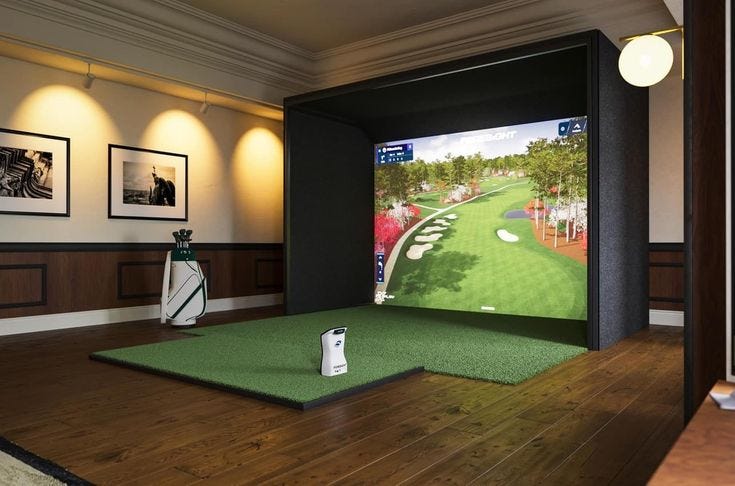
Slightly fat contact on a mat produces a passable result. The mat has some give. Real turf doesn’t. That same low-point position on grass produces a chunked iron or a heavy wedge. Some golfers report spending weeks recalibrating after a heavy indoor winter. The contact patterns the mat rewards are not identical to the ones the course rewards.
The Data Becomes The Goal
Swing speed. Ball speed. Launch window optimization. The list can be endless. Chase the metric long enough and you stop noticing whether the outcome is actually better. It can be a trap. Data is a diagnostic. It becomes a problem when you mistake it for the objective.
How To Use The Simulator Correctly
None of this should be a criticism of simulator/launch monitor use. If used properly, they can be transformational. There are numerous testimonials from amateurs claiming that regular use helped them shave anywhere from 3-6 strokes off their score.
The trick is knowing how to use one without getting lost in the simulator sauce — and actually taking the gains outside.
A few ways to make the sessions actually count:
1. Have a plan before you hit the first ball. Warm up with tempo work, not ego swings. Know what you’re working on.
2. Practice real shots. Shaped fades. Low punches. Varied targets. The simulator can handle it — most people just don’t ask it to.
3. Build a wedge matrix. Every yardage from 80 to 120, methodically. This is the highest-transfer work available indoors.
4. Add some friction. Worst-ball games. Ladder drills. Anything that introduces consequence. Pressure, even simulated, changes how you practice.
5. Track the right metrics. Smash factor. Dispersion window. Face control. Not max distance. Not your simulator score.
A few more things to remember:
The Simulator is a Lab, Not a Golf Course
Deliberate ball-striking work, dispersion control, face and path refinement, carry ladders — these transfer. Mindless 18-hole rounds and driver distance contests are entertainment. Both are fine. Be honest about which one you’re doing.
Get Outside Regularly
You have to play real golf. Every week ideally if you want to improve. Take your sim yardages to real turf. Hit some shots in the wind. Play from actual lies. Outdoor rounds are a check on your indoor work, and skipping them for months lets a gap open between what you think your game is and what it actually is.
Your Sim Score is Not Your Handicap.
Not even sure why I have to say this, but you’d be surprised at the number of guys I’ve heard tell me they shot a 75… on a simulator.
Treating it like an actual round of golf creates exactly the kind of false confidence that makes the real life recalibration worse than it needs to be.
Should You Buy One?
Full disclosure: I’ve been eyeing a launch monitor for the last couple of months. The price drop in the recent years make it hard to ignore — budget units that were north of $1,000 a few years ago are now sitting under $500. The barrier is lower than it’s ever been.
Here are just a few options if you’ve ever considered pulling the trigger. I already researched the highest rated picks for each price point so you don’t have to. But these would be the ones worth knowing about if you’re willing to spend.
I linked each of them to the seller with the best price at the time of writing.
Budget Option
Link: Garmin Approach R10

Mid Tier Option
Link: Bushnell Launch Pro Ball Enabled Launch Monitor

Higher Tier Option
Link: Garmin Approach R50 Launch Monitor

Final Takeaway
Launch monitors can improve ball striking, distance awareness, and pretty much all mechanical feedback. Those are real gains. However they don’t improve uneven lies, wind management, green reading, real turf interaction, or any form of competitive composure.
Paired with regular outdoor play and honest session goals — they probably accelerate improvement more reliably than anything else available to the average recreational golfer.
So use the lab. Just remember — it’s not the course.
Until next time,
Tommy
PDF Guides: Are available by clicking here for paid subs
Social Media: Make sure to follow me on X here.
It will be interesting to see in a decade what percentage of golf in America is played where it should be (indoors).