


Golf is a game of misses.
I bet you’ve never heard that one before…
But seriously — learning to miss well is a real skill. More specifically, learning where to miss around greens. Every golfer misses them. If you’re a 15-handicap, you miss roughly 13 per round.
The breakthrough comes when you realize no two misses are created equal. Every hole has a miss carefully designed to punish poor decisions.
This week’s post focuses on one of the most common green side misses, and maybe the most damaging:
The short-sided miss
(Cue the dramatic music)
How Common is a Short-Sided Miss?
Before I get into how damaging a short-sided miss is, let’s first figure out how often they occur. You could track your own short-sided misses per round — and you should — but that would take considerable effort and I don’t blame you for not doing it… So you can assume your percentages based on my math (risky).
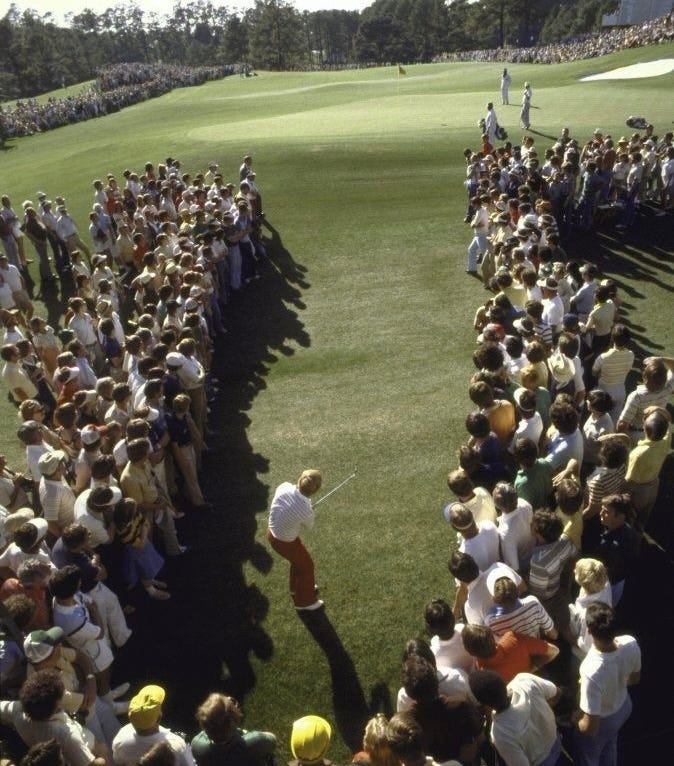
I’ll use Scottie Scheffler as the benchmark since he’s the only player I can find with a legitimately tracked short-siding stat. Luke Kerr-Dineen at Golf Digest hand-charted 1,353 of Scheffler’s shots from a 2024 stretch. So massive thanks to him. He only tracked his short-siding on back pin locations, so that’s what we’ll work with.
(Also side note, he is a great follow on Instagram. Follow him here if you haven't)
Based on his data, Scottie short-sides himself 2.82% on back-left pins, and 3.23% on back-right. Unbelievably low.
Spoiler alert: the amateur rates are going to be much higher.
It’s slightly difficult because no one publishes amateur short-sided miss rates. Measuring them would require miss direction and pin location for every shot. So we have to kind of deduce what the rates would be based off of other publicly available data.
A 15-handicap misses around 13 greens per round. Shot Scope’s data says 80% of those misses finish short. 47% short-right, 33% short-left. We’ll assume a third of pin placements sit on the right side, a third on the left, and a third in the center. Your miss only becomes short-sided when it matches the pin’s side.
The math:
13 missed greens
80% finishing short on a side (47% right + 33% left)
Roughly 33% of pins matching the miss side
That works out to roughly 3 to 4 short-sided positions per round for a 15-handicap. You can scale up or down for whatever your index is: assume 2 to 3 for a 10-handicap, or 4 to 5 for a 20 etc…

This comes out to a 17-22% short-sided rate for a 15-handicap. That's 6 to 7 times Scheffler's rate. He short-sides himself once every 30+ shots. You probably do it once every four or five.
You’re free to challenge my math/assumptions if you think I’m way off. I won’t be offended.
Side note: The short-sided miss is most common with a front right pin location since it directly coincides with the stock amateur miss — a little “flared” mis-hit short and right. You get a little excited, come over the top and catch it a hair heavy. Now you’re behind a bunker with zero green to work with because you thought you could take on the flag.
The Cost Per Miss
Ok so now we know roughly how often you’re faced with this miss. Now let’s figure out how many strokes it’s costing you. Similar to the frequency of the shot, we will have to make some assumptions based on the only data publicly available.
There are really only two data points available to us. The Mark Broadie research, and the Lou Stagner research.
Let’s start with Lou Stagner.
What Stagner did was pull real amateur shots out of the Arccos database, and sorted them by how much green sat between the ball and hole and then assigned a percentage.
For example, a 20 yard chip with the hole 16 yards from the edge is 80% green to work with. 20 yards with the hole 2 yards from the edge is 10% and so on.
The number Stagner got was +0.17 strokes for being short sided.
The 0.17 stroke figure comes from chips with 39% or less green to work with. That’s what he considered a “moderate to difficult” short sided chip.
He stopped at 39%. So we can assume that the penalty grows as the % of green to work with gets smaller.
One huge piece of context that is missing from the data (since it would be way too much work to gather) is that we don’t know anything about the penalty for each type of short-sided lie. All we have is the +0.17 strokes as an average of all the shots.
What I mean by this, is that let’s say some of those short sided chip shots were from behind a bunker with 20% of green to work with. I want to know what the penalty is for that shot. That way when I’m playing with a front right pin location and I see a bunker next to it, I can accurately weigh the risk/reward. As opposed to a front right pin with no bunker. In that case, maybe taking on the pin is worth the risk.
Broadie on the other hand measured something slightly different.
He built a Short-Side Index for the PGA Tour measuring moderate short-sided positions, and severe short-sided positions. From 29 yards in the rough, a tour pro in a severely short-sided position averages 3.06 strokes to hole out. From the same distance, same lie, in a moderately short-sided position: it takes them 2.72.
That’s a 0.34-stroke penalty per shot comparing one bad position to a slightly less bad one. For tour pros.
Here’s what’s interesting though. The penalty doesn’t scale upwards the worse the golfer gets. You would naturally imagine the 0.34 stroke penalty for pros would be something like a 0.5 stroke penalty for a 5-handicap. But Stagner's amateur figure is actually smaller. The reason is because amateurs were most likely going to bogey from either position anyway. The gap between bad and very bad matters more when you're capable of converting the bad one.

All of this is to say, the data isn’t as catastrophic as I thought it would be. Some of that is due to the fact that we just don’t have great data on it. But the data we do have certainly doesn’t point to short-siding being a scorecard wrecker in general.
Which means maybe the question isn’t “how do I avoid short-siding myself at all costs?” but instead “when is the risk worth it?”.
