


Putting is difficult. You know this. I know this. Everyone who has ever stood over a six-footer with something on the line knows this.
First you have to judge the speed. Then you need to read the overall break. Then you need to assess what the putt will do in the first 3 feet. Then you need to assess what it will do in the last 3 feet. Did I miss anything? Oh yea — then you actually have to execute a perfect putting stroke for any of this to even matter.
It’s no wonder we miss so many putts.
But this post is not meant to be about how to improve your putting stroke. I don’t give swing tips here, so we won’t cover that. Instead, this will focus on everything leading up to the putting stroke. Because if you can get all of that correct, it does make the actual putting part a whole lot easier.
When it comes to actually reading a putt, most amateur golfers skip it entirely. I mean sure, they walk up, crouch for five seconds, mutter something about “a little left edge,” and hit it somewhere on their line.
And then they miss it low.
I think green reading is one of the most underdeveloped skills in amateur golf. Usually the priority is mechanics first, green-reading second. And I understand that to a degree. You need a great putting stroke to hole putts — I agree. But if the data says 40% of your strokes happen on the green, then maybe doing everything you can to improve in all facets of putting is worth your time.
So let’s learn to read greens.
By the end of this, you’ll hopefully be more aware of every variable that influences a putt — and more importantly how to actually read them.
This is how I expect you to behave after reading the full post.
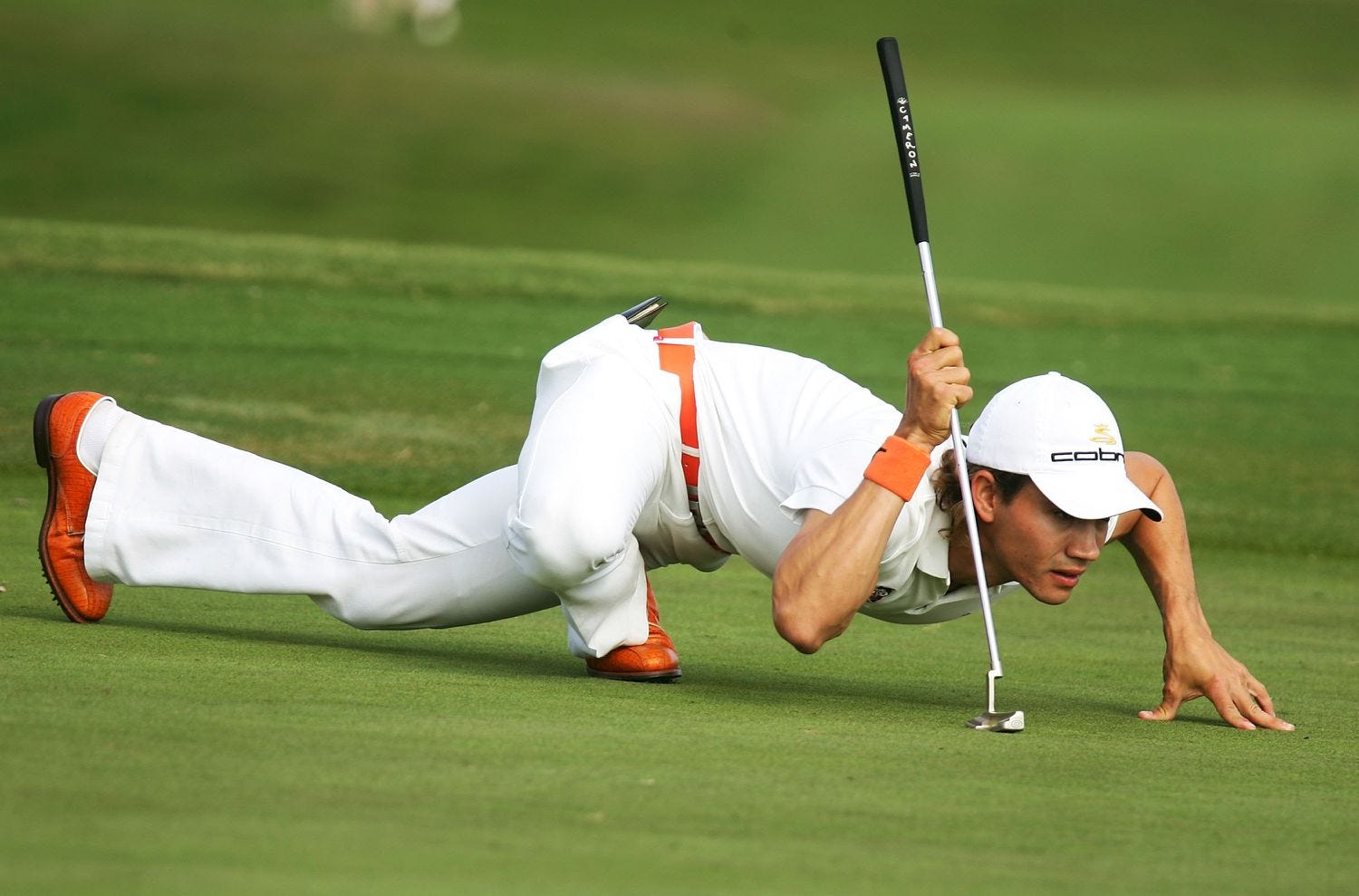
Under-Reading
Right off the bat, here is something that you need to know: PGA Tour players under-read left-to-right putts by roughly 30%. Right-to-left, about 15%. (This is for right-handed golfers).
The best putters in the world.
So if that’s at the top, and even they under-read putts, imagine where a 15-handicap is operating.
Take lag-putting. An under-read lag putt doesn’t just miss — gravity keeps pulling it offline with every inch it travels. The ball doesn’t slide past by a foot. It finishes dramatically wide and leaves a lengthy comeback putt.
Conversely, over-reading behaves differently. A putt played slightly too high often corrects itself, bending back toward the cup as gravity does its work.
What I want you to notice is that there is an asymmetry here. An under-read putt can finish up to six times farther from the hole than an over-read one.
Play more break. Almost always more break.
The Two Green Reading Pillars
Before getting into method, let’s get the physics straight. Every putt is a negotiation between two variables.
1. Slope
The primary driver. Greens are built for drainage — there is always a tilt from high to low. The shortcut that works: imagine pouring water on the surface. Where it flows, your putt breaks.
The insidious part: subtle slope is nearly invisible to the naked eye. A one-percent grade looks essentially flat. On a ten-foot putt at tournament speeds, that slope produces almost seven inches of break. Small slopes. Significant consequences.
2. Speed
Speed and line are inseparable. A firm putt spends less time rolling slowly across slope — gravity has less opportunity to work. A dying putt gives gravity more time, and more time means more break.
So if you’re moving from slow greens to fast greens, don’t just adjust your stroke. You also need to adjust your read. Fast greens don’t just require a softer touch. They require more break.
(I’ll add in an option #3 here: Grain)
This one is tougher to learn, but I’ll mention it anyway. Grain matters most on Bermuda, and it gets ignored constantly. The visual tells: shiny grass means you’re rolling with the grain, the putt runs faster. Dull or dark grass means you’re rolling into it, the ball slows down.
Check the cup. The worn, ragged edge of the hole typically points in the direction the grain grows. That’s more information.
Develop a System
It’s not that you aren’t “seeing” the break. You just never really had a process for reading the break to begin with.
You need to build a repeatable system. Most golfers read putts from a single perspective — directly behind the ball — and call it a read. That’s not a read. It’s more of a ritual lol.
If you watch Tour players, they have largely finished their read BEFORE they reach their ball. Their process begins while walking toward the green.
The Multi-Angle System
A reliable read involves multiple viewpoints. Each angle reveals something different. Here’s the framework:
