


Before the 2025 Masters, Jack Nicklaus pulled Rory McIlroy aside and gave him one piece of advice.
It wasn’t how to best attack Sunday pin locations. Or some Amen Corner secret passed down through the fraternity of past winners.
It was: “No f*cking double bogeys.”
Rory won his career grand slam.
The belief most amateurs hold is reasonable. Birdies are below par. Below par is the goal. Therefore: more birdies = lower scores.
That belief isn’t wrong. It’s just kind of irrelevant.
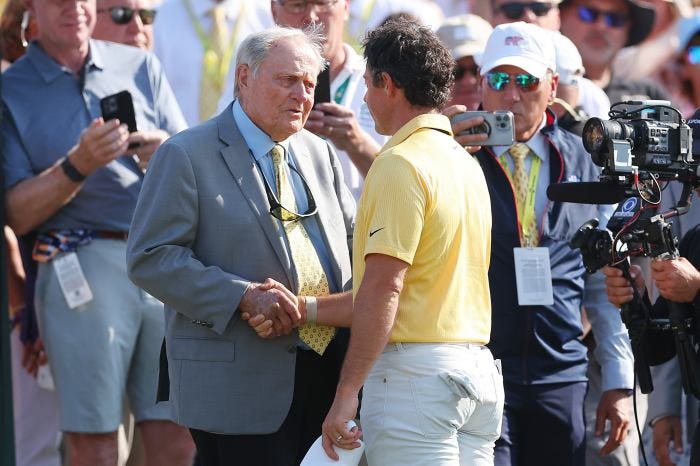
The greatest player who ever lived (arguably), gave one piece of advice to the man chasing a green jacket and a career grand slam, and the advice was the same your 15-handicap buddy gives you at your home Muni.
“Hey man, you should try to cut back on the doubles.”
There’s a reason.
The Proof
Arccos holds roughly nine hundred million amateur shots and eighteen million rounds. Lou Stagner is their lead golf data analyst, and is responsible for compiling and contextualizing most of their data, so huge kudos to him for this.
Here is their data on birdies and doubles per round by handicap:
Scratch: 2.2 birdies, 0.9 doubles or worse
5-handicap: 1.2 birdies, 1.4 doubles or worse
10-handicap: 0.7 birdies, 2.9 doubles or worse
15-handicap: 0.4 birdies, 4.7 doubles or worse
20-handicap: 0.3 birdies, 6.5 doubles or worse
I bolded the top and bottom lines because I want you to read them again.
A scratch player makes 2.2 birdies per round. A 20-handicap makes 0.3.
That is a difference of only 1.9 birdies per round.
A scratch player makes 0.9 doubles or worse. A 20-handicap makes 6.5.
That is a difference of 5.6 doubles or worse per round.
Sit with that for a moment...
This is transformative information. It should give every amateur hope. More importantly, it should reframe the entire way you think about scoring.
The gap that defines handicap is not the birdie gap. It’s the double bogey gap. By a factor of three.
Another way to view this: A 20-handicap who magically gained scratch-level birdie-making would save roughly two strokes a round. A 20-handicap who magically gained scratch-level bogey-avoidance would save six.
You’re chasing strokes in all the wrong places.
Why Birdie-Hunting Backfires
I know it stings. But unless you’re a very low single digit handicap, outright playing for birdie will probably produce more bogeys than birdies. There are a couple of realities you need to understand that will continue to help you reframe your thinking around this.
Birdies are rare. Doubles are routine
A 15-handicap makes about one birdie every three rounds. That’s roughly one birdie every 54 holes played. So even when one happens, you can’t magically engineer the next one. You simply cannot count on them to lower your score.
But what you CAN do is engineer fewer doubles.
The data shows there are five times as many opportunities to NOT lose strokes as there are to gain them.
AKA: Don’t be stupid.
Asymmetric risk/reward
Let’s take a flag tucked behind a bunker on the edge of the green. If a Tour pro gets aggressive and misses on the short side, on average it will cost him close to half a stroke. Not horrible.
He’ll probably be forced to hit some sort of 10-foot flop shot, and worst case have a 15 footer coming back to save his par. The risk may have been worth it.
But for most amateurs, being stuck short sided because they tried to take on a flag will cost them a whole lot more than half a stroke.
Factor in the chunky flop into the bunker, or the thinned wedge over the green. Now you’ve made double when you thought you could make birdie.
Start treating a bogey prevented the same as a birdie made. Your scorecard at the end of 18 holes will shock you.
Before we continue:
If you’re enjoying this week’s post and want access to the entire Scoring Letter archive, I’m running a little promo to receive 30% off an annual subscription for one year HERE.
The Tour Data
If hunting for birdies were the path, the Tour leaders in scoring average would be led by the birdie-makers.
But they aren’t.
The PGA Tour actually tracks this. There is a stat called Bogey Avoidance — the percentage of holes a player finishes worse than par. Lower is better obviously. Tour average sits around 16-19%.
Since they started tracking the stat in 1987, only three seasons have produced a bogey rate below 10%. You may recognize them. That's not a coincidence.
- Tiger Woods, 2000
- Scottie Scheffler, 2024
- Xander Schauffele, 2024
Across the 16 rounds of the Tiger Slam, he made 23 bogeys total. The next-best player who made all four cuts had 41.
In 2024, Scotty Scheffler led the PGA in birdie average AND bogey avoidance. He is the only modern player to do both in the same season.
I’ve heard many golf fans actually express how they don’t enjoy watching Scotty or Xander for this exact reason. They just hit the fairway, land on the green, and then two-putt. Sometimes one-putt. They are the opposite of the Jordan Spieth experience in this regard. It’s the reason why Jordan is so likable — he’s relatable.
When he lands in the trees and is fighting for his life to save par, it makes us feel seen. The only difference is he somehow turns the mess into a birdie while you make double.

So What Can You Do?
Ok so you’re probably thinking, “Sounds great. I’d love to make fewer doubles. Easier said than done. Can we stop with the vague abstract mindset stuff?”
Yes we can. Here is some specific and actionable advice you can use tomorrow to help eliminate doubles.
